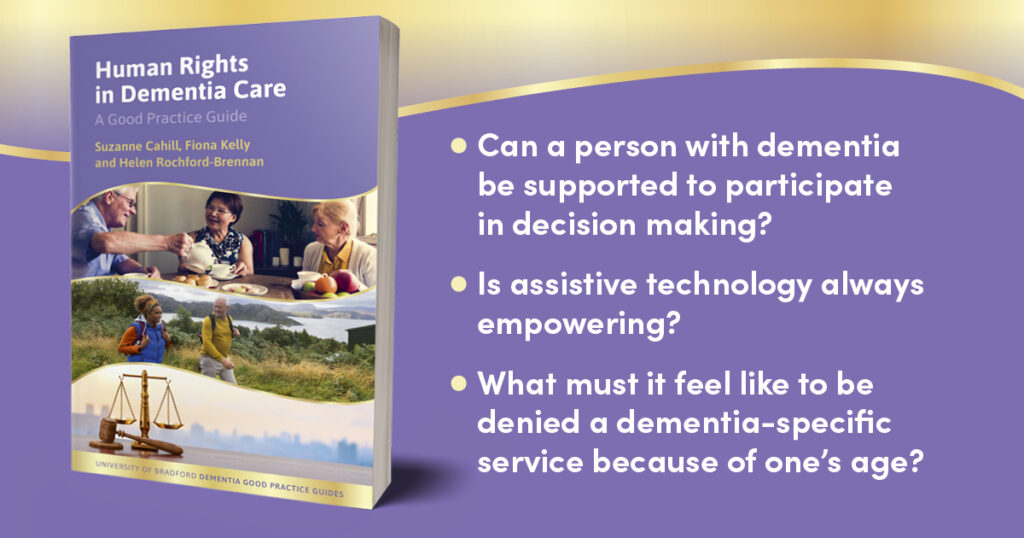
This blog piece has been written for us by Suzanne Cahill, Fiona Kelly, Helen Rochford-Brennan, authors of Human Rights in Dementia Care. It helps to introduce the key themes and goals of their book, and lets readers know what they can expect from it.
Discussing dementia as a human rights concern may at first appear counter-intuitive. Afterall, dementia is a health condition that has traditionally silenced and excluded the person; whereas human rights are about a person’s social inclusion, participation and equity.
However with more research being conducted into people’s experiences of living with dementia, we now appreciate the person’s vulnerability to human rights violation. This vulnerability can arise for a variety of reasons including, public and professional misconceptions about dementia that place the person at heightened risk of being excluded from decision making, marginalized, stigmatized and subjected to prejudicial attitudes and discrimination.
It is because of this, that we argue throughout the book, that dementia is a human rights concern. Indeed, that concern remains present at all stages in the person’s journey through the condition, but especially as dementia becomes more severe.
This book discusses dementia from a human right perspective, honing in on “the person” and not “the patient”, “their symptoms” or “the atrophied brain”. Throughout the chapters, we identify a wide range of human rights, that we believe can be threatened or breached in the course of the condition.
We align these rights with principles and standards set down in Conventions and legislation and we provide the tools and resources needed to help practitioners and family caregivers, ensure that the rights of the person with dementia are at all times upheld and respected.
We identify some reasons why rights violations can occur. Examples include poorly designed care settings, inadequate staff/resident ratios in care settings, limited staff training and support, poor clinical leadership and restrictive organizational cultures.
We argue that human rights violations can be both macro or micro; but regardless of their scale, any violation that affronts dignity and identity, will be harmful to the person’s physical and mental health and to their overall well-being and quality of life.
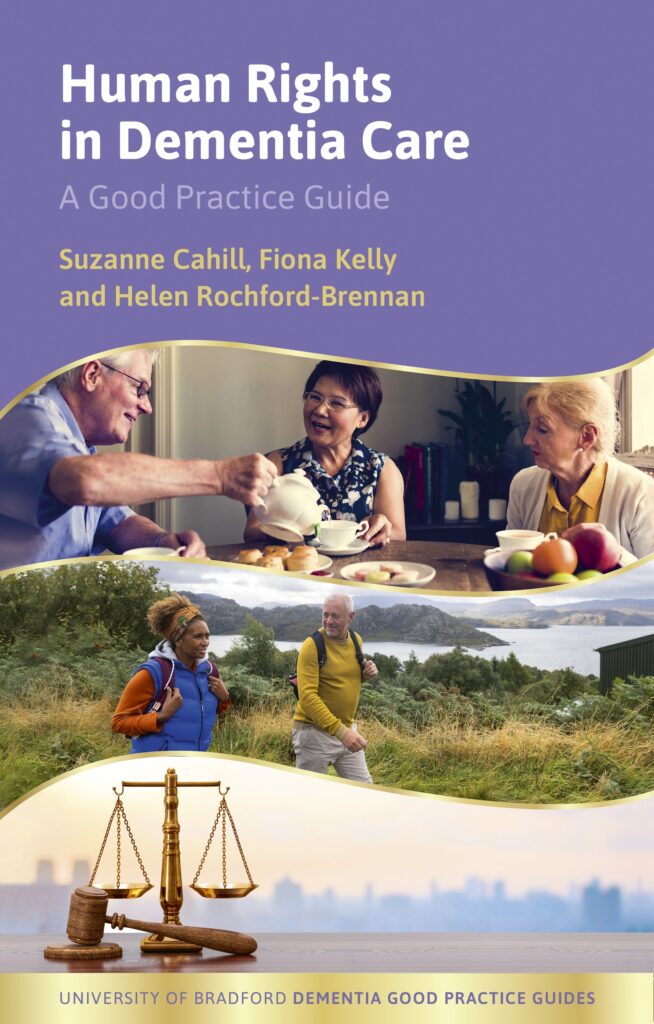
We believe that this book is hugely needed as despite advance in thinking about dementia, myths, misunderstandings and sub-optimal practices continue to prevail. These place the person at risk of being mal-treated, neglected and in extreme cases abused.
We hope that by bringing rights based principles and values to life in the book; through practice examples, research findings, and personal experiences, practitioners, family caregivers and anyone with an interest in dementia will be empowered to provide rights-based dignity-enhancing care and support.
Suzanne Cahill is Adjunct Professor of Social Work and Social Policy Trinity College Dublin, Honorary Professor of Dementia Care, NUI Galway, Affiliated Professor of Health and Welfare, Jonkoping University, Sweden.
Fiona Kelly is a former lecturer in nursing at Queen Margaret University, Edinburgh. Her own practice, teaching and research are informed by human rights.
Helen Rochford-Brennan is a Global Dementia Ambassador, Vice Chair of the Irish Dementia Working Group, former Chairperson of the European Working Group of People with Dementia and its nominee to the Board of Alzheimer Europe.
You can find out more about Human Rights in Dementia Care on the JKP website, or wherever you buy books.
If you’d like more free resources and updates on our latest books on dementia care, join our mailing list and choose how you’d like to hear from us.