Autistic Communication; Not As Simple As A, B, C.
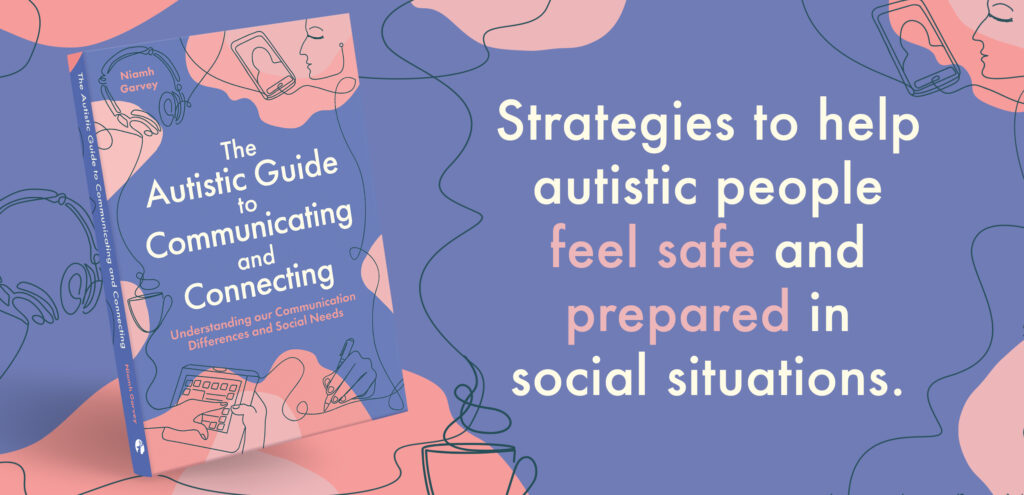
By Niamh Garvey, an autistic author from Cork. Find her latest book, The Autistic Guide to Communicating and Connecting here.
‘Why don’t you just say things normally?’
‘You’ve a got a weird accent, like you’re from nowhere.’
‘Why can’t you pronounce words properly?’
‘Why are you putting on an accent?’
‘It’s like you’re in your own world.’
I remember being asked these questions as a child. I’ve never been great at interpreting people’s tones of voice, but I knew enough to recognise that these were not friendly questions and comments. Knowing that something was ‘wrong’ with how I communicated, but not knowing why, nor how to fix it, created the perfect environment for shame to bloom and thrive. I often went silent, and spent more and more time in my own world.
The first lightbulb moment I had about why I communicate differently occured in my thirties, when I realised that I’m autistic- this taught me why I stuggled with tone of voice, facial expressions, social connection, and non-literal language. But I still didn’t understand why I’d so often been accused of using every day language differently, of using unusual words for my age, and why my accent was a mismash of many and none.
Thankfully, I had a second lightbulb moment when I was on a training course about autistic communication. I realised, with delight, that I was a Gestalt Language Processor (a term I had never heard of throughout a two year Diploma in Autism Studies, nor during my autism assessment and diagnosis process). Most non-autistic people are Analytical Language Processors (ALPs), and learn to speak by piecing individual words together, one by one, until they can say full sentences. Many autistic people are Gestalt Language Processors (GLPs), which means we learn language in chunks rather than individual words. GLPs begin speaking by learning phrases (which they tend to repeat again and again), and then progress to swapping words in and out of these learnt phrases, until eventually we can piece full sentences together word by word. In copying phrases, we also copy the accent from whom we learnt the phrase, and therefore when we mix and match phrases to form a sentence, we also mix and match accents.
As a child, I had learnt many phrases that had big or complex words in them, and I didn’t always remember to swap those words out to sound more ‘normal’. For example, I remember using the phrase “That’s not entirely true” as a baseline phrase, and I would swap out the word ‘true’ for other words appropriate to the context. I might have said “That’s not entirely… mine” or “That’s not entirely.. the way to the shop”. I didn’t yet know to drop the word ‘entirely’ as well as the word ‘true’, as I was still developing my language. But other people didn’t understand this, and rather than realising that I was failing to withdraw the word ‘entirely’, they assumed that I was precociously adding the word to appear more intelligent.
By the time I hit my pre-teenage years, I’d begun to study how other people communicated, and I began to copy. I used to write down different ways of saying the same thing so I could choose which phrase sounded the least precocious. I developed scripts ahead of social interactions, and practised different responses depending on how I predicted the conversation might go. A few years of speech therapy had improved my poor pronounciation, but I still had a mild lisp that I was hyper-aware of. I tried hard to sound like other people, both in terms of the words I used, and I how I said them. I began to put on a local accent and used more typical speech patterns, and by doing this, I stopped being accused of ‘putting on an accent’, or of using big words to appear intelligent. This didn’t come easy, and by my twenties, I was feeling intensely drained from trying so hard to avoid stigma and false assumptions- because having to think about how you say every sentence is exhausting and stressful. By my thirties, I was repeatedly being told to reduce my stress to manage my multiple auto-immune diseases, so it became clear that something had to change.
This is why my lightbulb moments were such a relief to me; I was finally able to stop seeing my communication style through the eyes of others, and start seeing them through my own autistic eyes. I needed to figure where the mismatches were occuring when I communicated with non-autistic people, and to figure out how we could work together to bridge that gap. And so, I began a deep dive into autistic communication. I process information best through writing, and so this deep dive evolved into a book, ‘The Autistic Guide to Communicating and Connecting’.
Despite there being a societal shift around autism, with more and more venues and services striving to become more autism-informed and accommodating (e.g by having designated sensory spaces and what-to-expect guides), there’s still a lag when it comes to autistic communication differences. But the willingess to learn is there, so now is the time for society to start learning more about autistic communication, to drop the assumptions and instead focus on making reasonable adaptations. We can learn to meet in the middle, and teach the next generation of autistic kids that communicating differently doesn’t means it’s wrong.
Niamh Garvey is an autistic author from Cork. Her latest book on autistic communication is called The Autistic Guide to Communicating and Connecting; Understanding our Communication Differences and Social Needs.
Other books she has published with Jessica Kingsley Publishers include the bestselling titles Looking After Your Autistic Self and Being Autistic; and what that actually means.