The practicalities of unschooling – what am I doing?
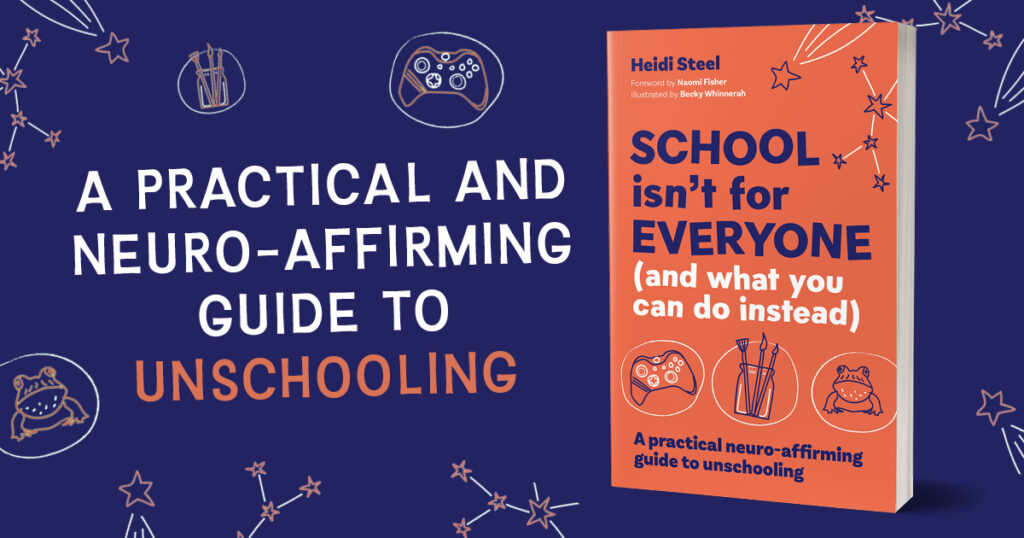
By Heidi Steel. Buy her book, School Isn’t for Everyone (and what you can do instead), here.
The idea of home educating can seem overwhelming.
Especially when you have a child that doesn’t want to do things that look educational.
They aren’t interested in worksheets.
They can’t sit at a table for more than two seconds.
They refuse to follow instructions.
It’s not their fault. And it’s not your fault either.
School is a familiar and well-known route and replicating school at home is often the first port of call. Most parents begin here when they start home educating. It makes sense when you realise that this is what we know, this is what we are familiar with. It is often the way in which we were educated ourselves: Reading schemes that are sequential; Worksheets so that we can demonstrate our learning; Targets so that we know what to do next; Teachers and curriculums so that we know we are learning the right things; A time for work and a time for play; And a timetable to keep us on track.
The truth is that it isn’t the only way to learn.
There are hundreds and thousands of children who are not only learning outside of school but they are learning as if school has never existed.
It can seem overwhelming in the beginning because it is so different to everything that we know. It can take time to change what life and learning looks like. It can be unsettling and unnerving. It can also be exciting. It can be joyful. It can be peaceful and restful.
Unschooling is an educational approach that changes everything we think we know about learning. It is founded on the idea that children can learn naturally. That we do not need someone to outline what we should be learning, when and how.
It can leave parents with the question, if we are not doing school at home, what are we doing? Here are five ways to introduce unschooling into your family.
Focus on the fun stuff
Your home and where you live is a treasure trove waiting to be discovered. Look at it like a staycation. Consider all the things on offer in your local area and suggest places to go and things to do that are on your doorstep. It might be exploring your local woodland, playing in the local water fountains, going to the library or a museum. Treat it like you would a family holiday and select the things that are enjoyable for you and your children.
If you prefer to stay at home, then go exploring in your own cupboards for games or toys that have been forgotten or spend some time putting together a watch list of favourite programmes. Remember, to focus on the fun and not worry about whether something is ‘educational’ or not. It’s all learning when the things that thy are doing are meaningful and enjoyable.
Look at the world with fresh eyes
Imagine, if you can, being a visitor from another country or an alien from another world. So often we forget that there are fascinating things all around us. Taking the time to slow down and see things afresh can help us to recognise how amazing the world that we live in is. From snails that climb up stone walls, decorative patterns on bed spreads or clothing, clouds floating in the blue sky or plants that grown out of roof tops.
Taking time to slow down, put aside the ‘to-do’ list, and seeing the world as if for the first time can foster awe and wonder. Allowing time to pause when they see something that catches their attention. Take their observations on the world seriously. Be responsive to their questions. In these ways, we nurture their natural curiosity and encourage their innate inquisitiveness.
Observe your child
Cultivating the skill of observation and discovering the things that light your child up or where their interests take them will put you in good stead. It will enable you to become confident in your child’s organic ability to learn, to be engaged in things that are meaningful to them, and to explore and engage with life on their own terms.
It doesn’t matter what your child chooses to do. Playing with toys long beyond school age, not following the instructions, never finishing a project, playing with toys in unprescribed ways, it doesn’t matter. Extended interests in Barbies, Pokemon, computer games, digging, animals, Japan, it doesn’t matter. Whatever it is, your observations will mean that you can now facilitate your child’s interests.
Join in their activities
After observing your child’s choices, it’s now time to join them! And if you’re not sure how to make a freeze frame animation, play Minecraft or don’t feel artistic then now is the time to learn together. The lovely thing about not being the teacher is that you don’t have to have all the answers or know how to do everything. You can figure it out together.
One of the cornerstones of unschooling is developing a strong relationship with your child. Coming alongside them, playing their games, crafting next to each other, and splashing in rivers together is a beautiful way to do this. Spending time joining them in their activities is a simple and easy way of valuing their choices.
Listen to your child’s voice (accept the no)
Whilst we are answering our child’s questions, identifying what lights them up, playing alongside them, leaning into their choices, and expressing the things that they do what to do, it does mean that we will also find them voicing when they do not want to do something. This last one is possibly the most difficult because as a society we are not used to honouring our child’s ‘no.’
Without it though, your child cannot make a meaningful choice. Being able to learn naturally means being able to confidently follow your own thread of curiosity, which in turn means leaning into the things that interest you and being able to say no to the things that are not for you. Having a voice that is honoured and understood within the family and beyond into community, and being accepted for who you are (the ‘yes,’ the ‘no’ and all the uncertain bits in-between!) builds self-esteem and confidence. It also situates you as a trustworthy and safe person in their lives.
In short, we are creating an environment in which learning can flourish and parenting in such a way that makes learning easy. Prioritising your relationship with your child, responding to them, and facilitating their choices, means that you can curate a life where learning flows from a place of joy, peace and ease.
Heidi Steel runs the consultancy LivePlayLearn, providing support to families who need a different form of education. She set up the podcast Unschooling Conversations, a monthly webinar that delves into life and learning through an unschooling lens. Her book School Isn’t for Everyone (and what you can do instead) is out now.