When Menopause Meets ADHD – The Perfect Storm That No One Warned You About
Lotta Borg Skoglund is a certified specialist in family practice and psychiatry/addiction and the medical director of SMART Psychiatry, living with ADHD. She specialises in treatment and assessment of neurodevelopmental disorders.
Imagine spending forty years learning to manage your brain. Not through any formal support and most of the time without even knowing what you were managing. Purely by sheer, accumulated effort. You finally think you know which strategies work. You have carefully tailored and finetuned a structure so that the day doesn’t collapse. You are painfully aware that things usually fall apart the week before your period, and you have, somehow, figured out ways to shore yourself up.
And then, in your mid-to-late forties, everything you thought you mastered stops working.
You lay awake a full night for no obvious reason. Your focus, something you micromanage carefully, is all over the place. You forget words mid-sentence, names of colleagues you have known for years, the word for the thing you went to the kitchen to find. Your emotions feel disproportionate and difficult to locate. You are starting to fear that there is something seriously wrong with your brain.
For women with ADHD entering perimenopause, this is not an unusual experience. And most importantly, it is, researchers and clinicians are beginning to understand, a predictable one.
Estrogen – the silent regulator
To understand why perimenopause can be so destabilising for women with ADHD, it helps to understand what estrogen actually does in the brain.
Estrogen is not simply a reproductive hormone. It is a powerful modulator of neurotransmitter systems, including dopamine, norepinepherine and seretonin, which all lie at the very heart of ADHD. When it comes to dopamine, a key neurotansmittor in ADHD, estrogen appears to increase availability, affecting cognitive function, attention and mood. When estrogen levels are high and stable, many women with ADHD find that they can compensate relatively well for their challenges, although for many with energy draining strategies.
Perimenopause may disrupt all of this. Unlike menopause itself, in which hormone levels are low but stable, perimenopause is characterised by extreme and unpredictable fluctuation. Estrogen can surge higher than normal, then plummet. Progesterone, more of an on/off switch depending on whether ovulation occurs, adds its own variability making the experiences even more complex. For a brain that is already sensitive to changes and fluctuations, this is seldom a gentle transition. It is, as one woman in the book described it, like going through a second puberty, except that this time, there was no expectation of turbulence, and no one warned her about it.
The symptoms that get missed — and the diagnosis that never arrives
The perimenopausal symptoms that women describe, brain fog, difficulty organising and prioritising, emotional dysregulation, memory lapses, worsening of sleep quality, overlap substantially with ADHD. For women who have lived their intire lives undiagnosed, perimenopause may be the moment at which previously compensated-for ADHD symptoms finally cross the threshold of visibility. They can no longer compensate or mask their way through the day and keep up the performance.
Many will, when they present in health care settings, be told that this is depression, unrealistic demands in life or exhaustion. They may be offered antidepressants, mindfulness courses or sick leave. Some may be identified as having perimenopausal symptoms and offered menopausal hormon treatment with estrogen that often helps for hormonal symptoms but may be insufficient to relieve the problems related to undiagnosed ADHD.
Most health care systems are nietly organised in vertical silos, based on what medical profession doctors and nurses are specialied in. The female body however, does not respect these practical enteties, but rather streches out horisontally across them. As a consequense, women with ADHD are passed between specialists; a gynaecologist who does not ask about cognitive function, a psychiatrist who does not ask about hormones; a reumatologist narrowing in on the migrating pain. No one willing or equipped to hold the whole picture.
What research is beginning to show is that women with ADHD experience more cognitive and mental health difficulties in perimenopause and menopause than women without ADHD. Executive functioning, the ability to plan, organise, initiate tasks and manage time, seems to be particularly affected. Clinical experience accumulated across years of working with neurodivergent women describes the same pattern: this is a particularly vulnerable transition, and it is arriving for women who have, in many cases, already spent a lifetime without adequate support.
The courage of late diagnosis
For some women however, perimenopause is not only a crisis. It can also be an unexpected doorway.
The collapse of long-used coping strategies can finally bring women into contact with the right clinician, at the right moment, asking the right questions. Women in their fifties are receiving ADHD diagnoses and describing, sometimes with grief for the decades lost, but also with unmistakable relief, the experience of finally having a name for what they have been up against their entire lives.
This matters. A diagnosis in midlife is late, but not too late. Access to correct treatment, whether medication, hormonal support, practical strategies, or prefereably all three, can be genuinely lifechanging. Understanding the relationship between one’s ADHD and one’s hormonal status can make sense of a lifetime of experiences that have otherwise only generated shame and sinking selfesteem.
There are real, practical strategies that can help women across their entire reproductive lives: tracking ADHD symptoms in relation to the hormonal cycle; discussing with a doctor whether PMS- or perimenopausal symptoms warrant hormonal treatment, with specific attention to the ways ADHD and hormonal fluctuation interact; and thinking carefully about the practical challenges of managing medication consistently matters more when many medications used for ADHD also iinteract with hormonal fluctuatios across life.
What needs to change
The gap between what women with ADHD experience across the perimenopausal transition and what the healthcare system is currently prepared for is significant. The research base, though growing, is still small. The clinical experience of women with ADHD going through this stage of life is still limited to a group of specifically interested and invested helath care professionals.
But the knowledge exists to start doing better. It begins with healthcare professionals understanding that brain fog, emotional dysregulation and executive dysfunction in a perimenopausal woman may hit women with ADHD earlier and harder. And it continues with giving the women themselves a voice to advocate for a more complete picture of their health.
Perimenopause should not the beginning of decline, because for many women, it is the beginning of finally being understood.
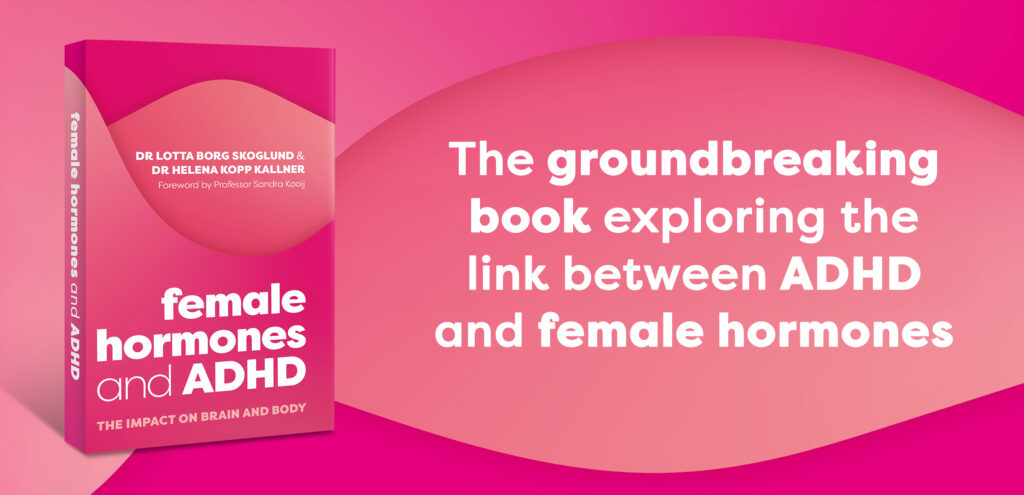
Read more about Female Hormones and ADHD, the book by Lotta Borg-Skoglund that explores everything from ADHD and common cooccurring conditions like anxiety, eating disorders and PCOS, to hormonal treatments and contraception.