How My ADHD Diagnosis Has Changed My World For the Better
Laura Kerbey is the Founder of PAST & Co-founder of KITE. Author of The (Slightly Distracted) Woman’s Guide to Living with an Adult ADHD Diagnosis & public speaker providing training and support on Neurodiversity. Proudly neurodivergent.
At 46 years old, I was diagnosed with ADHD – and honestly, it’s one of the best things I’ve ever done for myself.
Why? Because finally understanding my brain’s quirky operating system completely rewired how I saw myself, my behaviour, my relationships, my parenting, basically everything, right back to my earliest memories.
Before the Diagnosis
Someone recently asked me what difference it would have made if I was diagnosed earlier, and my response was that it would made a huge difference as I always thought of myself so negatively before my diagnosis. Before my diagnosis, I carried around a long list of unflattering self-labels: clumsy, lazy, forgetful, oversensitive, disorganised, weird, impatient. In short: a bit of a walking disaster.
Like many late diagnosed and self-identifying women, my lightbulb moment came when my child was diagnosed with ADHD. His paediatrician casually mentioned that it was highly likely either me or his dad was also neurodivergent. Spoiler: it was me. And I wasn’t alone; there’s been a tidal wave of women discovering (and embracing) their neurodiversity later in life.
The truth is, not everyone can—or wants to—go through the full official diagnosis process. That’s why self-identification is every bit as valid.
Why It Matters
Understanding why your brain does what it does, whether through a formal diagnosis or self-discovery is a total game-changer.
My diagnosis helped me realise that, yes, I’m still a bit weird (and I wear that badge with pride), but there’s absolutely nothing “wrong” with me. When I struggle in certain environments, it’s not because I’m broken—it’s because that environment (and sometimes the people in it) simply isn’t compatible with my ADHD brain. Understanding my brain means I am not only kinder to myself, but I am also advocate for myself better, put necessary boundaries in place and remind myself that a lot of the time my brain is skewing the truth from me.
The other important thing I have learned about my ADHD, is that I don’t have a deficit of attention, the opposite is true, and I actually have too much attention. My challenge has always been directing that attention in the right measures to the right things.
The Ripple Effect
ADHD touches every corner of life. Research shows that women with ADHD are more likely than their neurotypical counterparts to experience:
- Anxiety — the kind where your brain convinces you of the absolute worst scenario about pretty much everything!
- Sleep disorders — because why should your brain rest just because you’re lying down?
- Postnatal depression — the kind that convinces you you’re failing as a mum, when in reality you’re working harder than anyone just to keep it all together (and doing an amazing job).
- Hormonal curveballs — including PMDD (premenstrual dysphoric disorder), fertility issues and even greater challenges during menopause.
- Addiction — when your brain’s search for dopamine goes overboard.
- Rejection Sensitivity Dysphoria (RSD) — where even a slightly raised eyebrow can feel like the ultimate put-down.
- People-pleasing — often at the expense of your own needs.
Basically, ADHD adds a few extra levels to life’s difficulty setting. Without understanding the hardwired reasons behind those challenges, it’s easy to end up blaming yourself, comparing yourself to people who seem to sail through life, and thinking you’re not good enough.
The Kindness Factor
Learning how my brain works has made me kinder to myself. I’ve become better at managing impulsivity and shutting down negative thought spirals. These days, if someone doesn’t reply to my text or email straight away, I don’t automatically assume I’ve upset them and I can tell myself they’re probably just busy. (It works SOME of the time!)
Knowing my brain also means I can advocate for myself and set boundaries to protect my wellbeing.
From My Story to Ours
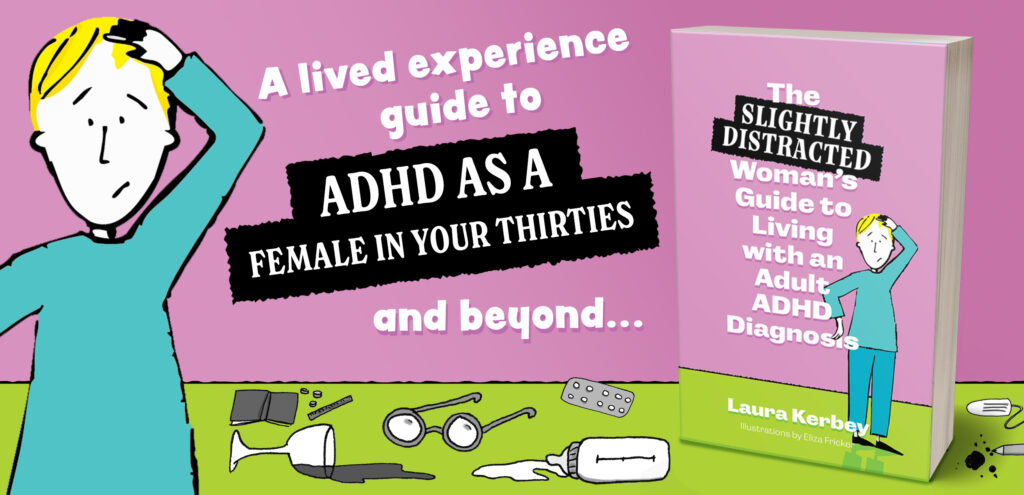
I don’t want any other woman to feel like she’s not good enough or is “failing at life.” That’s why I wrote The Slightly Distracted Women’s Guide to Living with an Adult ADHD Diagnosis. (Yes, the title is long. Short and snappy just isn’t my style!)
When I began writing, I invited other late-diagnosed and self-identifying women to share their experiences. Reading their stories made me feel validated, seen, and comforted; proof that I wasn’t alone in bouncing from one disaster to the next before I understood my ADHD.
The book became a chorus of women’s voices. They were different ages from different locations, but united by their experiences as late diagnosed women.
In the final chapter of the book entitled, “Dropping the Disorder and Reframing My ADHD” I rename my diagnosis as “Adventurous, Determined, Hardworking and Dedicated” and I also write a compassionate letter to my younger self and invite the reader to do the same.
I want any woman with ADHD who reads this book to understand that we are neither deficient nor disordered. We are amazing women with brains that simply work differently.