‘People with DID or OSDD Are Possessed’: What Myths Are There Around Dissociative Identity Disorder?
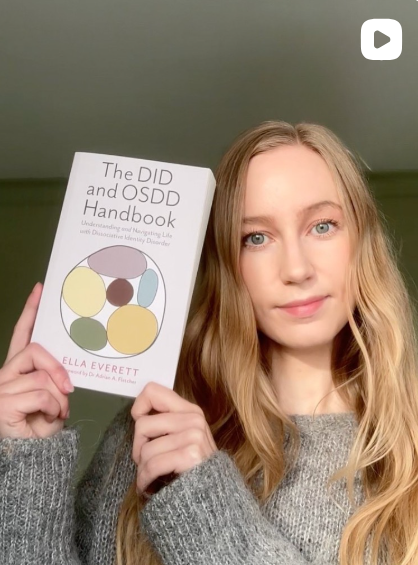
Unfortunately, many inaccuracies exist when it comes to people’s assumptions about dissociative identity disorder (DID) and other specified dissociative disorder (OSDD). In The DID and OSDD Handbook, Ella Everett debunks some of the most common myths. Read this extract from Chapter 2 to read about these surprising falsities.
Myth: DID and OSDD Are Not Real
This is false. The UK Rare Diseases Framework states that ‘a rare disease is defined as a condition which affects less than 1 in 2,000 people’1. It may seem like a difficult concept to comprehend, that multiple alters can exist in one body, but it is possible. The creation of alters is an adaptive coping mechanism in response to childhood trauma. Everyone dissociates and DID and OSDD are just a more chronic and complex form of dissociation. DID and OSDD are both listed in the DSM-5 and ICD-11 as mental health disorders and are only diagnosed by trained mental health professionals. Brain scans have also shown evidence of alters switching and systems exist all over the world. Research has challenged the idea that people with DID are simply pretending. Psychophysiological and neurobiological differences were found between people with DID and healthy controls who were instructed to pretend they had DID.2
Myth: You Will Know If You Are a System
This is false. You may have DID or OSDD but not yet know you have it. This is due to dissociative amnesia, which protects systems from knowing about their trauma and other alters, allowing them to get on with everyday life.
Myth: DID and OSDD Are Rare
This is false. The UK Rare Diseases Framework states that ‘a rare disease is defined as a condition which affects less than 1 in 2,000 people’. At least 1 in 100 people in the world has DID or OSDD,3 this means DID and OSDD are not rare. This is a lot of people. The United Nations stated the world’s population in 2022 as 8 billion. That means in 2022 there were at least 120 million systems worldwide.4
Myth: People with DID or OSDD Have an Evil Alter or Are Criminals
This is false. People with DID or OSDD are no more likely to be dangerous than the average person. They are actually more likely to be the victim of a crime than the perpetrator of one.5 The book Dissociative Identity Disorder: Treatment and Management states ‘no criminal association or link is found with DID’.6 The film Split7 is about someone with DID who has ‘evil’ alters. This is a cinematic trope used to create an ‘interesting’ storyline. The film is widely criticised for its inaccurate and stigmatising portrayal of DID. Systems do not have ‘evil’ alters.
Myth: People with DID or OSDD Are Possessed
This is false. This interpretation was made in the past before much was known about mental illness and trauma. It may still be prevalent in some communities today, such as within some religious communities. However, contemporary research, neuroscience, psychology and clinical practice all recognise DID and OSDD as mental health conditions and not as possession.
Myth: DID and OSDD Are Personality Disorders
This is a common misconception and is false. DID and OSDD belong to a group of mental health conditions called dissociative disorders, which is a separate and different category to personality disorders.
Myth: You Can Tell if Someone Is a DID or OSDD System
This is false. Multiplicity is only obvious in around 6 per cent of systems who present more overtly.8 The myth that all systems are visibly identifiable creates a false narrative which can lead to biases.
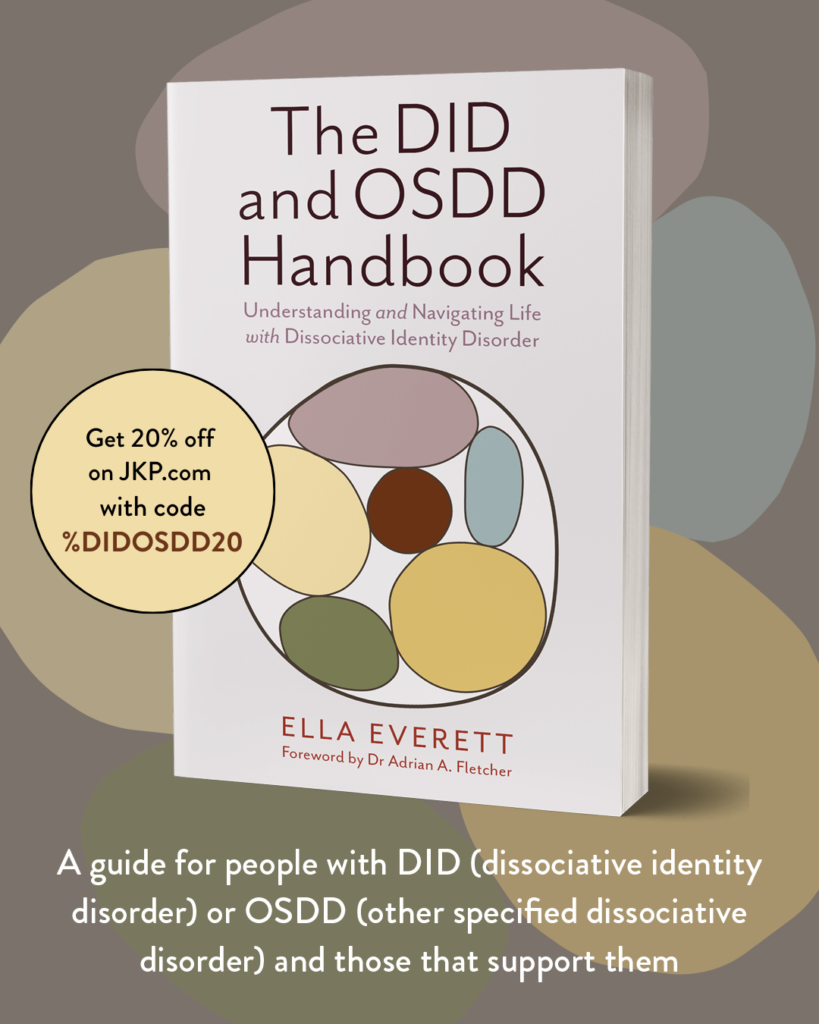
For more DID and OSDD myths be sure to check out The DID and OSDD Handbook: Understanding and Navigating Life with Dissociative Identity Disorder by Ella Everett.
- American Psychiatric Association (1994) Diagnostic and Statistical Manual of Mental Disorders, 4th edition (DSM-IV). Arlington, VA: APA. ↩︎
- American Psychiatric Association (2013) Diagnostic and Statistical Manual of Mental Disorders, 5th edition (DSM-5). Arlington, VA: APA ↩︎
- World Health Organization (2025) ‘Dissociative identity disorder (6B64)’, International Classification of Diseases 11th Revision (ICD-11). Accessed on 14/02/25
at: https://icd.who.int/browse/2025-01/mms/en#1829103493 ↩︎ - Dell, P. and O’Neil, J. (2011, first published 2009) Dissociation and the Dissociative Disorders: DSM-V and Beyond. New York: Routledge, p.694. ↩︎
- World Health Organization (2025) ‘Partial dissociative identity disorder (6B65)’, International Classification of Diseases 11th Revision (ICD-11). Accessed on 21/06/2025 at: https://icd.who.int/browse/2025-01/mms/en#988400777 ↩︎
- International Society for the Study of Trauma and Dissociation (2011) ‘Guidelines for Treating Dissociative Identity Disorder in Adults: PHASE-ORIENTED TREATMENT APPROACH and EPIDEMIOLOGY, CLINICAL DIAGNOSIS, AND DIAGNOSTIC PROCEDURES.’ Journal of Trauma &
Dissociation, Third Revision, 12:2, p.118. Accessed on 21/04/22 at: www.isst-d.
org/wp-content/uploads/2019/02/GUIDELINES_REVISED2011.pdf ↩︎ - American Psychiatric Association (2013) ‘Dissociative Disorders, Dissociative Identity Disorder, Prevalence’, in Diagnostic and Statistical Manual of Mental Disorders (5th edn). Arlington, VA: American Psychiatric Association, p.294. ↩︎
- American Psychiatric Association (2013) ‘Obsessive-Compulsive Disorder, Prevalence’, in Diagnostic and Statistical Manual of Mental Disorders (5th edn). Arlington, VA: American Psychiatric Association, p.239. ↩︎