Beyond the Stigma: The Hidden Strengths of Living with Borderline Personality Disorder (BPD)
By Rosie Cappuccino. Pre-order her book, The Talking About BPD Workbook, here.
Life with a diagnosis of Borderline Personality Disorder (BPD) can be laden with challenge and confusion. Firstly, there are the intense, overwhelming emotions and distressing urges that may feel hard to handle. Secondly, there is the wide-ranging stigma that can make it hard to access compassionate support or feel safe enough to talk openly about your life. This is before even mentioning that BPD is one of the most contested diagnoses in psychiatry.
But what if amongst the complexities and contentions that complicate life with this diagnosis, there are strengths that tend to go unseen and unacknowledged? In fact, what if the very aspects that lead an individual to be diagnosed with BPD might actually be some of their greatest strengths?
I’m thinking about traits such as the capacity to experience emotions vividly and at high volume; the immense value individuals tend to place on meaningful connections; their resistance to injustice and readiness to acknowledge and care deeply for others.
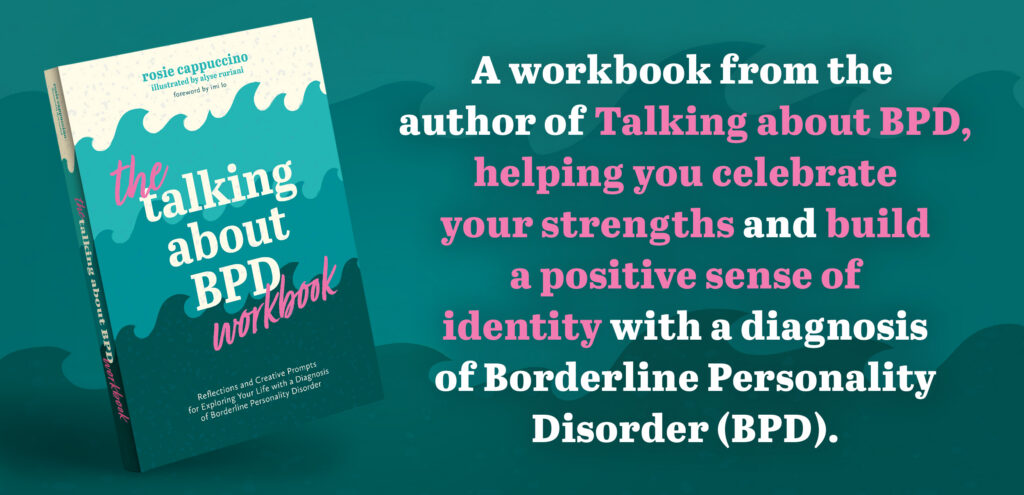
It’s this kind of thinking that readers can expect to find in my new book, The Talking About BPD Workbook: Reflections and Creative Prompts for Exploring Your Life with a Diagnosis of Borderline Personality Disorder. Most books about the BPD diagnosis take the so-called flaws of individuals as their full focus. Instead, my book asks readers to look at themselves through the lens of what they already offer the world and the people they love.
The result, I hope, is a book that is comforting, hopeful and, consequently, useful. After all, when a person feels that core aspects of their identity bring value to the world and their relationships, they tend to feel safe enough to explore new ways of being and relating— to both themselves and to others.
Exploration is at the core of my book. I don’t tell my readers how they should feel or think about themselves, their struggles, their diagnosis, their life. After publishing my first book about my experiences of life with the BPD diagnosis, I became curious about finding new ways of thinking about myself, my emotions, relationships and identity as a person whose emotional experiences have often been misunderstood. I share the kinds of questions I asked myself, in the hope that you might find thinking from new angles as liberating as I do.
As I wrote in the acknowledgements, friendships emerged as a surprisingly thought-provoking site of thinking as the book took shape. The honesty and generosity within my friendships enabled me to challenge my assumptions about what friendships look like, how much I hide versus how much I share, and the mechanics of shame in relation to the stigma I’ve experienced.
Relationships, including friendships, are therefore a key theme of the book— along with others such as creativity, critical thinking and finding the words for experiences that sometimes feel beyond articulation.
As relationships tend to be where the most painful challenges arise for people with this particular set of emotional experiences, they are also where the most fruitful transformations may happen too. This is what I want my readers to hold onto when they feel— as individuals with this label are often led to beleive— ‘too emotional’ or ‘too much’.
I’ve had a decade of living with and writing about the BPD label. I’ve had countless conversations with people who experience their emotions and relationships in similar ways to me and I’ve noticed the kinds of friendships that people with this diagnosis tend to develop and maintain. Contrary to stereotypical depictions, these friendships are often mutually-fulfilling, close connections ripe with learning and exchanges of support.
Often there is a remarkable level of honesty that might not be seen in other friendships because explicit statements about how both parties are feeling and asking for clarification may help people with the BPD label feel safe in a friendship. This frank, yet gentle, relating tends to facilitate rich conversations and a rare type of closeness.
People with a diagnosis of BPD tend to take their connections with others seriously. They therefore tend to be friends who are intentional— who aim to remember birthdays, send messages to show care or give encouragement, often without the expectation of it being reciprocated.
Most individuals with the BPD diagnosis have been through, or continue to go through, difficult experiences such as trauma, stigma, discrimination and feeling silenced. As friends they are driven towards being nonjudgmental and gentle with others’ spoken or unspoken vulnerabilities.
Experiencing intense emotions and caring deeply about relationships is a valid and meaningful way of existing and being, but is often not seen as such. I hope my book brings readers comfort, hope and new perspectives on the riches they offer this world and their relationships.
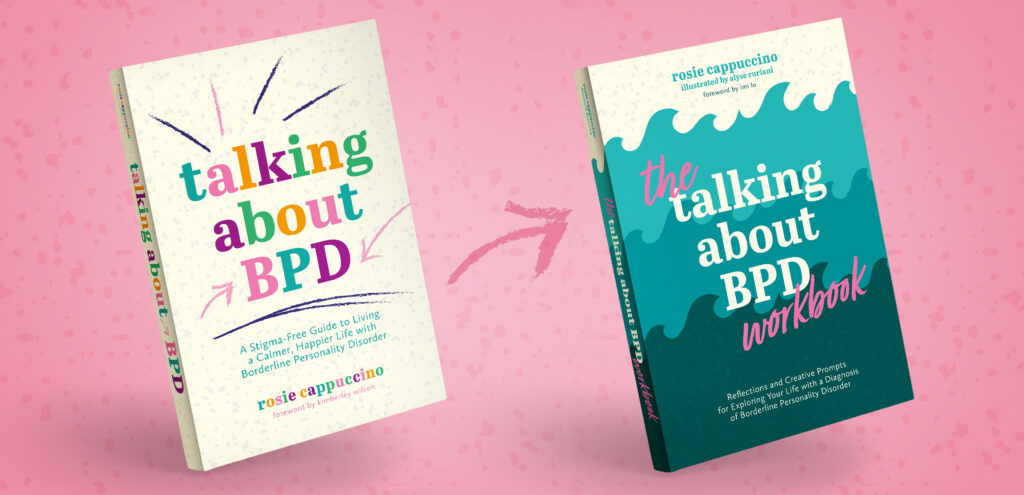
Rosie Cappuccino writes the award-winning blog Talking About BPD, sharing her experiences of life with a diagnosis of BPD since being diagnosed in her early 20s. She writes for Happiful, has previously written for Healthy Place, and has appeared on podcasts such as Mentally Yours and The Stronger Minds Podcast. Rosie works as a teacher in the UK, has a Master’s Degree in Medical Humanities and is also on the Editorial Board for the BMJ Medical Humanities. She is the author of Talking About BPD and The Talking About BPD Workbook.