What is Neurodivergent Culture?
Joe Wells is a comedian and works in stand-up as well as writing for the BBC and magazines. His latest book, co-authored with fellow comedian Abigoliah Schauman is Neurodivergent Moments.
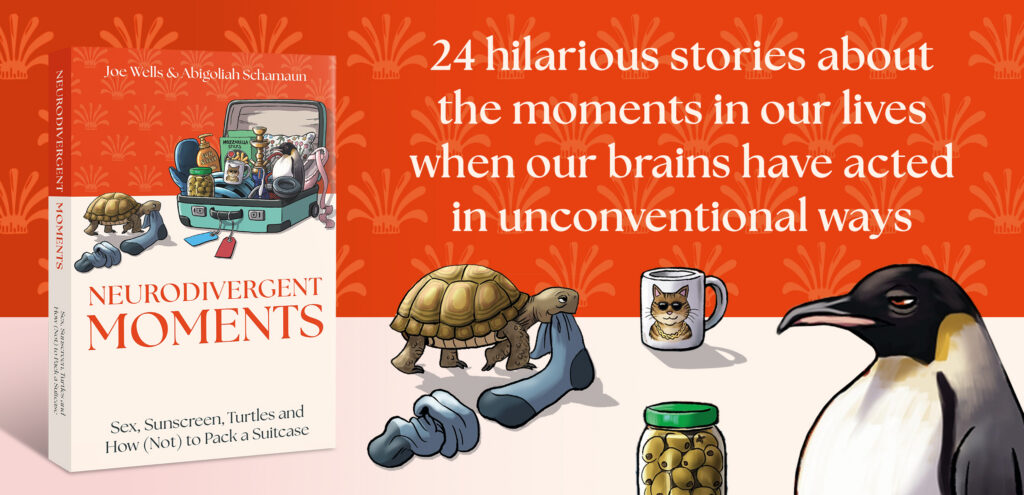
I’ve got a book coming out of funny stories from my life as an autistic man. There’s one about my wife stealing some cheese, one about a tortoise and a very embarrassing story about my bum (pages 89 to 92 if that’s what you’re into). I co-wrote the book with my friend and fellow comedian Abigoliah Schamaun who has contributed her own stories with an ADHD angle. It’s been described as “quietly political” which conjures up an image of me whispering “Nigel Farage is a knobhead” gently under my breath – something I do regularly.
When my publisher asked me to write a blog I thought I’d make my quiet political point louder and it is this… I believe that Autism, as well as referring to a clinical diagnosis, can refer to the culture of the people with (or who would meet the criteria for) that diagnosis.
We’re quite used to groups of people having a culture and we’re quite used to the definitions of those cultures being fuzzy, malleable, and having crossover with other cultures. For example; pizza is part of Italian culture, but certain types of pizza are part of Italian-American culture, not everyone who makes a good pizza is Italian and not all Italians eat pizza. Despite all these caveats it still makes sense to put pizza under a definition of Italian food culture.
Similarly, there are cultural phenomenon which I believe can be stored under the definition of “autistic culture”. Last year I did stand-up comedy at a geocaching meetup, and my people were very well represented. I’m still not entirely sure what geocaching is but I know that it’s autistic. It is true that many autistic people have a special interest in trains, Warhammer, or superhero comics. These interests are obviously not definitions of Autism, I’m autistic and indifferent to all them (except for trains which I actively despise), but it’s uncontroversial to say that these are interests which many autistics have gathered around, enjoyed and contributed to.
It can sometimes be hard to separate autistic culture from autistic stereotypes. The science-loving, comic book obsessed, Sheldon Cooper from the mediocre sitcom The Big Bang Theory has received criticism for being a stereotype of an autistic man, but when I asked a comedian what the audience were like who came to his Marvel themed comedy show he had one word for me – autistic.
The difference between autistic stereotype and autistic culture can be summed up perfectly by this quote from autism-rights pioneer Polly Samuel (FKA Donna Williams)
“…right from the start, from the time someone came up with the word ‘autism’, the condition has been judged from the outside, by its appearances, and not from the inside according to how it is experienced.”
Polly was one of the first autistic people to write “from the inside” but since her groundbreaking books in the 90s there have been hundreds more. As more of us speak, write, and create “from the inside” then it becomes clearer what “autistic culture” is.
We are seeing how autistic culture is more diverse than the stereotypes. The satirical news site, The Daily Tism, is run by autistic women and satirises aspects of autistic culture beyond the stereotype that only men are autistic. Kala Allen Omeiza’s novel, Afrotistic, pushes against the stereotype of the white male autistic.
An elderly man once came up to me after a comedy show and told me that he really enjoyed my set but there was some of it he didn’t understand, “what is autism?” he asked. Almost all of my set was about being autistic so I’m not sure what part of it he enjoyed, he was probably being polite.
It was a difficult question to answer. What is Autism? It’s a disability, or should I say it’s a condition which means that people are disabled under the social model? Or is it not a condition people have but a thing people are? What criteria do people have to meet to be autistic and what if that criteria changes, as it has done many times? Does anyone have a copy of the DSM 5 to hand?
I am sure that the neat definitions of autism used in academic research and in formal diagnosis have their uses, but the full definition of what autism is includes all of autistic culture. It is the collective experiences of all autistic people, the different ways we communicate, the special interests we gather around, the art and music we produce, and even my story about a tortoise.