What Does It Feel Like to Experience Narrative Therapy?
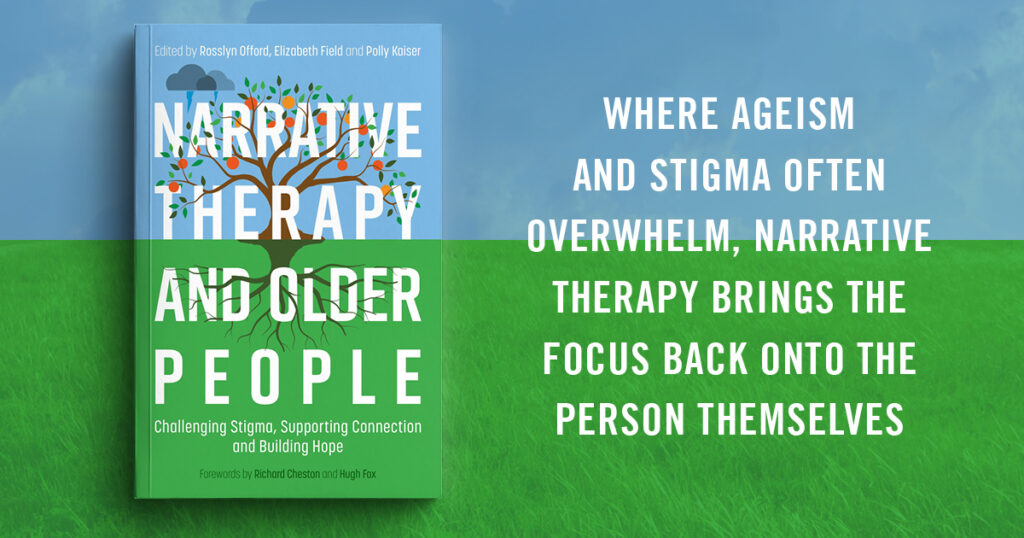
This is an extract from the chapter ‘Using Narrative Therapy to Help Navigate the Journey in Becoming a Dementia Care Partner’ by Rosslyn Offord and Karen Gibbs, taken from Narrative Therapy and Older People, edited by Rosslyn Offord, Polly Kaiser and Elizabeth Field. Buy your copy here.
We, Karen and Rosslyn, have known each other through the Cardiff and Vale Young Onset Dementia team for several years. We met initially when Karen’s husband, Nick, requested help following his diagnosis of Alzheimer’s disease at the age of 55 and asked if there might be any support for Karen. We have worked together in different ways, reflecting the different needs Karen has had as her and Nick’s situation evolved and changed. More recently, we have reflected on what it has been like to work using a narrative therapy approach. We share a passion for improving the care of people living with dementia and their supporters. Rosslyn has talked with Karen about the lack of research and literature relating to using this approach in dementia care, and together we felt we could play a part in improving this by sharing our experience with others. In this chapter, we hope to share our experience of using narrative therapy in a way that assists both supporters/carers and clinicians in understanding both how this approach works and how it can be helpful. We also hope it might be helpful to people living with dementia, who may be looking for ways to support themselves in connecting to helpful stories of identity, as well those who support them. We thought it would be helpful to discuss the following:
• How it felt to Karen being offered psychological therapy and what helped her to get started.
• Some of the emotional and psychological aspects of being a carer of someone living with dementia.
• What using narrative therapy looks like.
• What it is about narrative therapy that might be particularly helpful to carers of people living with dementia.
First, a note about terminology. We recognise that people caring for someone living with dementia and people living with dementia have different preferences for the term we use to describe the person in the caring role. Karen uses the word ‘carer’, so we will use this term in this chapter.
Getting started with narrative therapy
Karen
It was Nick who requested support from psychology initially. He had a sense that this would be helpful. At that time, he was still working and we couldn’t be open about his diagnosis. Nick was getting support as a patient, and I was included alongside him, but I wasn’t offered this personally. He asked: ‘Is there something you could do for Karen?’ I knew I needed something. When you’re a carer you’re still mentally okay, but the person with dementia isn’t and you automatically take on the care and support of them. At the same time, you’re trying to feel your way through this forest of the unknown – What’s ahead? What’s around? No one could tell me how long it’s going to last, and it’s so difficult to understand the condition itself. This made it difficult to work out how I could accept this diagnosis, what it is, how should we tell people and so on. There is a stigma around dementia, especially at 55. People don’t know how to approach it, especially when no one can tell you what the outlook is. All you know is that someone has pulled the rug from under your feet, and you are struggling in a very isolated way.
Although I knew I needed something, I didn’t know where to find it. The literature isn’t very helpful. It tells you about all the practical things, but what I needed was help in coming to terms with those deep emotions, and I had no idea what that would look like. In our case, it felt unhelpful that the literature is mostly written for people diagnosed in older age, which added to the sense of stigma. I had received an appointment on formal NHS paper inviting Nick and me to an appointment with a psychologist, but I was thinking, ‘What are we going to? Are we going to be labelled?’ It’s slightly unnerving to get NHS letters anyway, then there’s the stigma about psychology and psychiatry too. In the back of my mind, there was all this American stuff about ‘going to see my shrink’ and lying on a couch. I went not knowing if it was a test or not. Someone like me has no idea of what psychology is or how it can help. We went to a strange little room, and it did feel odd for a while. However, Rosslyn explained things. She and her colleague were welcoming and kind, and I realised this was not an inquisition. They helped me to understand the safety of talking with them. I understood that our conversations would be confidential, and I could see that they were professional, well-trained and sympathetic. I could feel that they were not going to be judgemental. I understood from them that this was support for me rather than any kind of medical intervention.
What using narrative therapy looks like
Karen
At the beginning, what helped was a psycho-educational course for dementia carers called START (STrAtegies for RelaTives programme; Livingston et al. 2019). It helped me to know I was being given something solid that had been developed by University College London. There were helpful suggestions in each unit, and I felt as if I was learning. Doing an individualised course, where I could talk about my experiences in this structured way with a trainee psychologist, was helpful in the first instance, as I could get used to the idea of opening up and feeling comfortable with someone else in the room. It was helpful for me to be able to see the development in my understanding over time. It helped me to learn strategies, especially around relaxation and mindfulness. For me that was a really good introduction.
For a while, I was able to use the strategies I had learned with START to carry on caring for Nick, and that felt like enough. However, over time, the doctor realised I could do with a bit more help. She would meet Nick and me every 6 months for a review and arranged to have some one-to-one time so that I could speak openly. She asked how I was coping with life at home. I found it quite emotional, and when she asked if some further psychological support would help, I knew that it would. Although I had done the START course with psychology before, I didn’t know I could ask for it. I’m not sure I would have asked for it if I’d realised it was available. Maybe I would have done, but I was brought up to cope if you can. There was a sense for me that I didn’t feel I deserved it: I know how stretched the NHS is, and Nick is the patient, not me.
What using narrative therapy has been like
Karen
Your full-time caring commitment leaves you very little room to think too much about yourself, but actually it’s very important to give yourself some time. It’s difficult to find and there’s so much to do. This hour I have, now just every couple of months, is reassuring. It’s just for the carer, it’s not for the person you’re caring for. It’s an hour just to spend on yourself and come to terms with what you are really thinking and feeling. A lot of the time you are suppressing those thoughts in order to cope. This gives you a chance to let go of all those inhibitions and let the emotions flow. I can say why caring can feel so irritating or why it’s so sad or terrible. I’m speaking to somebody who is a professional person, who isn’t just a friend and who isn’t going to judge me. Rosslyn is there to support me rather than say, ‘Why don’t you do this or that?’ or ‘I know’. You have a listener for yourself for an hour who is actually helpful in asking questions to allow you to explore your own thoughts and own ways of managing. By the end of an hour, I feel like my situation is clarified each time. I feel quite drained, but I feel I can carry on. I can continue. I feel like I have been helped to get to grips with the emotional reality of the situation and its life-changing effect.
Click here to download the full chapter.
Rosslyn Offord is an NHS Consultant Clinical Psychologist based in South Wales. She has a special interest in using psychotherapy with people affected by dementia and has found narrative practice transformative.
Elizabeth Field is an NHS Consultant Clinical Psychologist. She enjoys using narrative practices to help older people and those who work with them tell their stories in ways that link lives and challenge stigma.
Polly Kaiser is a semi-retired old age clinical psychologist. She helps support the ‘Greater Manchester Mature Minds Matter’. She has always campaigned for age equality and now has skin in the game.
Narrative Therapy and Older People is out now.