By Dr Hannah Belcher: author of Dealing with Change, Loss and the Unexpected, and an autistic advocate, lecturer and researcher, with a PhD in camouflaging, mental health and late diagnosis in autistic females.
In the last five years we have seen the rise and fall of 5 different Prime Ministers, that is more than we saw in the 20 years prior to 2022. The political climate has been rapidly changing, at a rate that is hard to keep up with. I’m not even sure who our Prime Minister is right now! As tensions rise, so do divides within society, and many of the changes affect autistic people directly.
In 2022, the world opened its doors again following the Covid-19 pandemic, but many struggled financially with the cost-of-living crisis it resulted in. Children had to go back to school after being home schooled throughout the pandemic, people had to go back to work after being furloughed, and the shops and public transport were busy once again. It was a traumatic time for all of us, but especially hard for autistic people struggling with change and transitions, whose mental health had been severely affected (Bundy et al., 2022). Then came the death of the Queen, the only Head of State any of us had known, followed by the 2024 general election, which saw the end of the Conservative government after 14 years in power. This brought about new reforms to the NHS, economy, employment, and immigration. Some of these were quite drastic and have left many of us living in uncertainty about our own situations. Groups are being attacked left right and centre, as debates around immigration, transgender rights, and welfare cuts have hit the headlines and continue to stir up divisions. Many autistic people are represented in these groups, particular within the trans community and those who rely on benefits.
We know change can be hard for autistic people to manage; a core trait of autism is the need for routine and ‘rigidity’ around changes. But so little research and support is available to help us, particularly in these very difficult times we are facing. One of the biggest uncertainties affecting us right now is that of healthcare and welfare. We have seen rhetorics around ‘overdiagnosis’ of autism, particular from Reform MPs, combined with cuts to both mental health services and welfare, rapidly gaining more traction in the media. These arguments suggest that there’s too high a demand for support services for autistic people, and people are being over medicalised for ‘normal’ problems. This has fuelled debates around too many autistic people receiving benefits like Personal Independent Payments, too high waiting lists for diagnoses, and increased financial pressure on mental health services. But how is this affecting autistic people day-to-day?
While all these debates and changes are happening at a national level, they cause feelings of uncertainty in all of us who are autistic. Potential benefit cuts have led many of us to grow increasingly worried about how we will survive on less/no financial support. We are at a substantially higher risk of mental illness than the general population too, which will no doubt increase as we suffer from more detrimental changes to our lives (Underwood et al., 2022), making potential cuts to mental health services frightening. Not to mention the number of people on lengthy waiting lists who haven’t even got their autism diagnoses yet and who cannot access support until they do! In 2024, the leading autism research and campaigning charity in the UK, Autistica, reported autism assessment waiting times of between 2-2.5 years for adults, stating that the number of people waiting would fill a city bigger than Bolton! (Autistica, 2024). The growing belief (of which there is no evidence) that autism is being overdiagnosed, threatens to increase these issues rather than tackle them.
Uncertainty can make us extremely anxious. In an unpredictable world, we need things around us to be predictable and certainties promised. Uncertainty intolerance, which can affect us so badly we shut down or meltdown, is highly common (Boutler et al., 2014), as do transitions, of which we are experiencing quite rapidly each time a new Prime Minister comes into power. Our brains are not wired to adapt to change well, plus the increased stress we experience daily in our lives heightens our fear and need for control even more. But while these changes are beyond our control, which makes them even harder to manage, there are things we can do to lessen its effect on us.
Firstly, it’s important to stick to the facts and avoid sensationalised headlines, opinion pieces, and the comment sections on these articles. Many of these changes haven’t come into play yet and may never do. Organisations like the National Autism Society, Autistica, and Autism Action are fighting our corner and demanding better support for autistic people from the government. A recent parliamentary response to the accusations of “overdiagnosis” reported that this rhetoric was increasing stigma for autistic people and that we actually have an “underdiagnosis” problem (Authority of the House of Lords, 2025). With the National Strategy for Autistic Children, Young People and Adults coming to an end in 2026, the House of Lords Autism Act Committee is calling for a new strategy (Abreu, 2025), and an increase of £140 million is expected to be pumped into mental health services by 2027 (Streeting, 2026). While uncertainties around benefits still exist, and some payments have been decreased and/or stricter criteria applied, there has been a reduction in unnecessary repeat assessments for those with lifelong conditions (such as Autism) and increases to Universal Credit payments. Focussing on these positive changes can help us mitigate from the fear being fuelled by the media.
Another strategy to lessen anxiety around uncertainty and changes, is to look at the things we can influence and things we can control. We can’t control the decisions of others, but we can get involved in advocacy work with autism organisations that could influence these policies. We can write letters to our MP’s and share our lived experience to raise awareness. Most importantly, we can focus on our own health and wellbeing. We can choose to avoid reading social media posts, to some extent we can control how we react, we can ensure we take the time we need to unwind and focus on more positive activities in our lives, and we can create routines and structures within our lives.
Another great strategy, that was suggested to me by Jamie + Lion, an autistic advocate, while I was writing my book, is to find activities in which we can get into a positive ‘zone’. Some autistic people refer to this as hyperfocussing on their ‘special interests’. Whatever it is that you enjoy doing, dedicating time for this can help you create a safe space where you can’t be distracted, taking your mind away from all the stress and worry.
I am a strong advocate of self-compassion and ensuring we get ‘down time’ from the things in our lives that are increasing anxiety and overwhelm. This can look different for different people. It might be surrounding yourself with sensory objects you enjoy, exercise that helps you relieve stress, or just time to be completely alone with no pressures. This time is vital for us; we cannot just keep going until we ‘burn out’.
Lastly, it can help to talk to others, especially other autistic people. You will probably find they share the same anxieties you do and have developed their own, unique ways of coping with these. Or maybe it is a therapist that can help, if you’re finding that you’re so overwhelmed by the uncertainties and changes in your life that it is affecting your mental health. If you find yourself too isolated to reach out to others, autism support groups can be a great step, and they usually exist in most areas of the country.
While it is true we exist in an ever-changing world, there is one certainty in life and that is that everything will change! As terrifying as that sounds, it does also mean your bad feelings and the hard situations you face will change too. By focussing on ourselves and the positive changes we can make, we flex those networks in our brain that can help us cope with more negative changes too. We can also take control of the things that are within our power and surround ourselves with the things we enjoy and the people we feel safe with, like a layer of protection from the outside world.
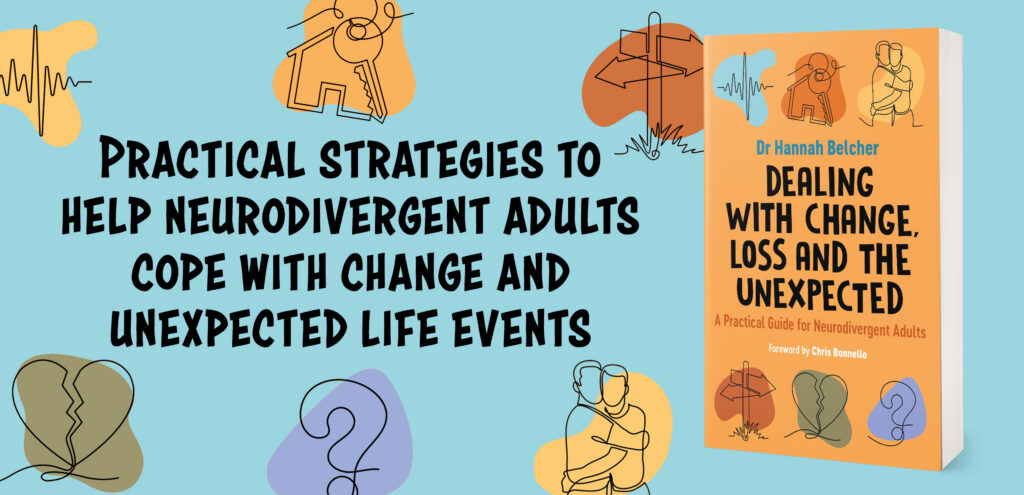
For more information on dealing with changes and uncertainty, my book “Dealing with Change, Loss and the Unexpected” offers lived experience and strategies for coping with all of life’s uncertainties.
Helpful resources
https://www.citizensadvice.org.uk/debt-and-money/cost-of-living/get-help-with-the-cost-of-living
https://www.autism.org.uk/what-we-do/branches
https://www.mind.org.uk/information-support/tips-for-everyday-living/autism-and-mental-health
References:
Abreu, L. (2025). Autism policy and services: UK legislation and strategies. House of Commons Library. https://commonslibrary.parliament.uk/research-briefings/cbp-10231/
Authority of the House of Lords. (2025). Time to deliver: The Autism Act 2009 and the new autism strategy. Select Committee on the Autism Act 2009. Time to deliver: The Autism Act 2009 and the new autism strategy
Autistica. (2024). ‘Not a Priority’ Highlights Crisis in Autism Assessment and Support. https://www.autistica.org.uk/blog/not-a-priority
Boulter, C., Freeston, M., South, M., & Rodgers, J. (2014). Intolerance of uncertainty as a framework for understanding anxiety in children and adolescents with autism spectrum disorders. Journal of autism and developmental disorders, 44(6), 1391–1402. https://doi.org/10.1007/s10803-013-2001-x
Buckland, R. (2024). The Buckland Review of Autism Employment: report and recommendations. Department for Work and Pensions. https://www.gov.uk/government/publications/the-buckland-review-of-autism-employment-report-and-recommendations/the-buckland-review-of-autism-employment-report-and-recommendations
Bundy, R., Mandy, W., Cook, J….et al. (2022). The impact of early stages of Covid-19 on the mental health of autistic adults in the United Kingdom: A longitudinal mixed-methods study. Autism, 26(7) https://doi.org/10.1177/13623613211065543
Kallitsounaki, A., & Williams, D. M. (2023). Autism Spectrum Disorder and Gender Dysphoria/Incongruence. A systematic Literature Review and Meta-Analysis. Journal of autism and developmental disorders, 53(8), 3103–3117. https://doi.org/10.1007/s10803-022-05517-y
Underwood, J. F. G., DelPozo-Banos, M., Frizzati, A., Rai, D., John, A., & Hall, J. (2023). Neurological and psychiatric disorders among autistic adults: a population healthcare record study. Psychological medicine, 53(12), 5663–5673. https://doi.org/10.1017/S0033291722002884