Bringing Playfulness to Yoga with Autistic Children
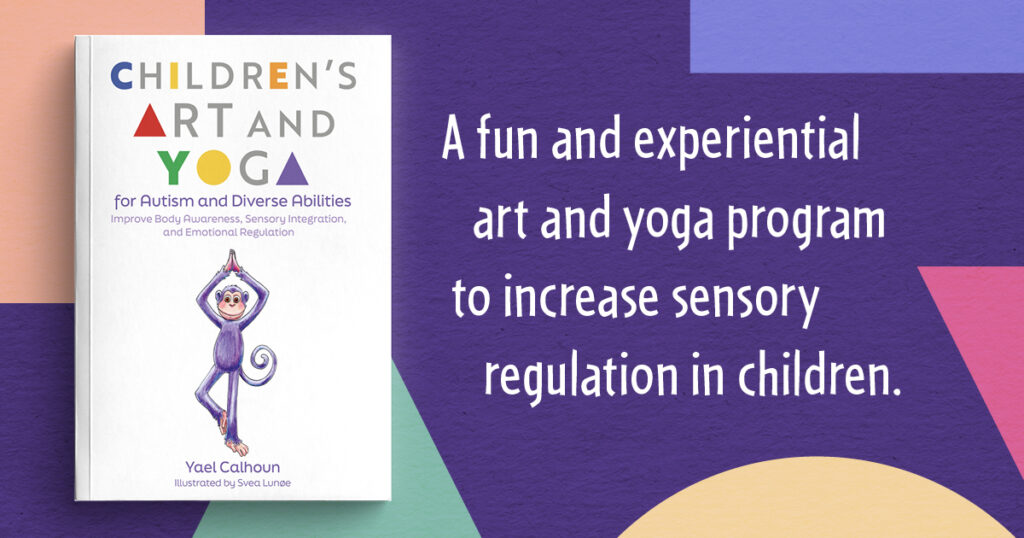
Yoga sessions with autistic children can be joyful, engaging, and empowering when the right elements are in place. Yael Calhoun talks about bringing the fun into yoga sessions with children, and what you can expect to see in her book, Children’s Art and Yoga for Autism and Diverse Abilities.
What’s key in working with children with physical, emotional, behavioral, or mental challenges? Having fun. It’s an idea worth repeating. Your program needs to be fun. What isn’t fun? Being told what to do and how it should make you feel isn’t fun. Being talked at and confused by ‘too many things’ isn’t fun. What else isn’t fun? Having a teacher who is stressed or unsure about what they are doing. Okay, so how can you create a fun program that empowers these children to self-regulate and to build physical awareness and confidence?
A simple guide to help meet the changing needs of your children is the new book: Art and Yoga for Children with Differing Needs and Autism. This book provides an easy-to-use guide with sensitivity to the many processing issues these children may experience. The good news is you do not need a specialized degree to share this program. And the program is based on the trauma-informed GreenTREE Yoga® Approach of building safety, supporting empowerment, and maintaining simplicity.
The book chapters are designed to support your efforts to build a flexible program, the benefits of which can extend well beyond the class time. The art and yoga program can lay the groundwork for short yoga breaks that both children, teachers, and parents can practice at home or at school. To support your teaching efforts, this book includes simple science to both inform and to inspire your program development. The detailed scripts, charts, and art project instructions and many supplemental resources provide easy-to-follow and easy-to-adapt ideas and suggestions.
Let’s start by looking at class outline. You can get a sense of what you can offer and if you think it is a good fit for your programs. You can notice if you think it’s…you guessed it…fun.
Each class has a predictable and simple order.
- The Hello Song: Connecting with song engages each child as you build social connection and body awareness. The Hello Song is sung quietly to greet each child. The child chooses a quiet finger snap or hand clap for all to do as they sing the personal greeting.: Explain you would like to sing to each person who can choose a hand movement to do as you all sing. “Let’s practice the choices. First a soft clap. Now a soft finger snap.” It is as simple as: “Kaya chose finger snaps. (and you all snap as you softly sing) Hello, Kaya. Hello, Kaya. Hello, Kaya. Were glad you came to yoga.”
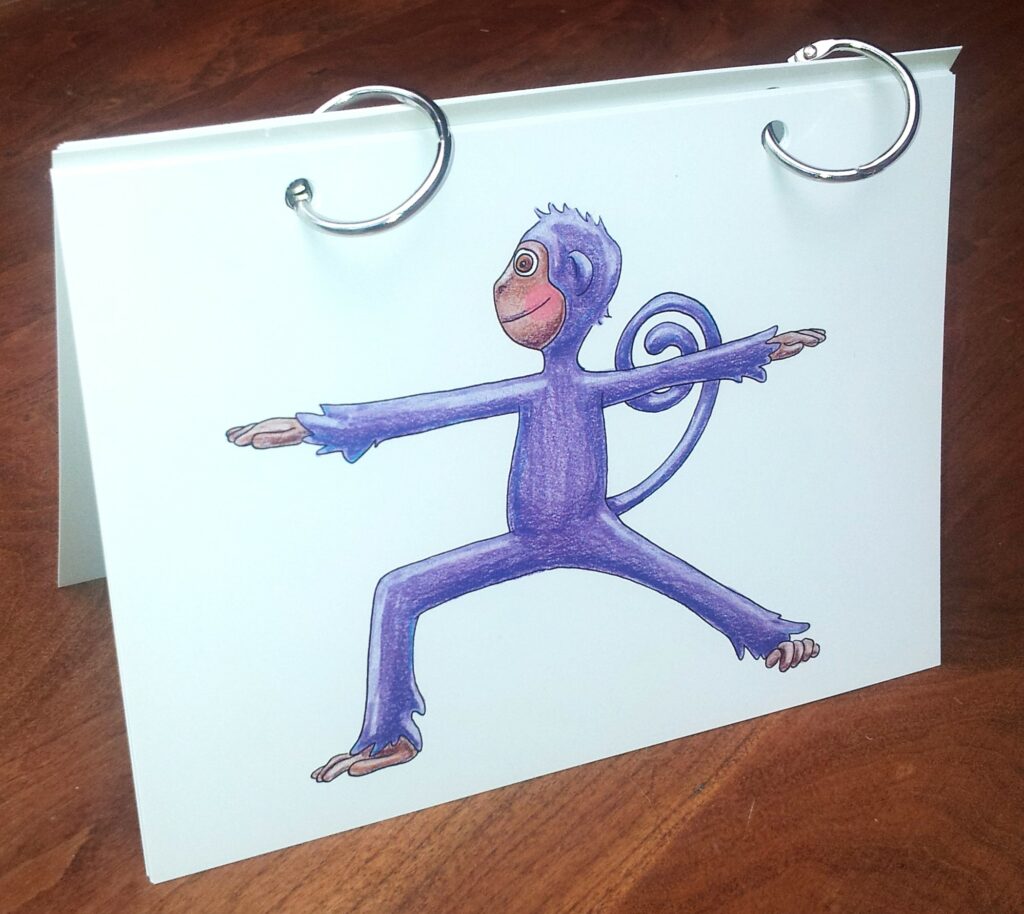
II. Yoga Part 1: The engaging Shanti the Monkey flip chart is on a stand next to you for visual cues and to assure there is a predictable class order as you move through the poses and breathwork.
- Lion Pose
- Breathwork: (choose one)
- Seated Twist
- Butterfly
- Cat/Cow
- Snowball/Snowflake
- Downdog
- Mountain/Star
- Pose of the Day:
Day 1: Triangle Pose
Day 2: Rocket Pose
Day 3: Tree Pose
Day 4: Cobra Pose
Day 5: Warrior Two
Day 6: Eagle Pose
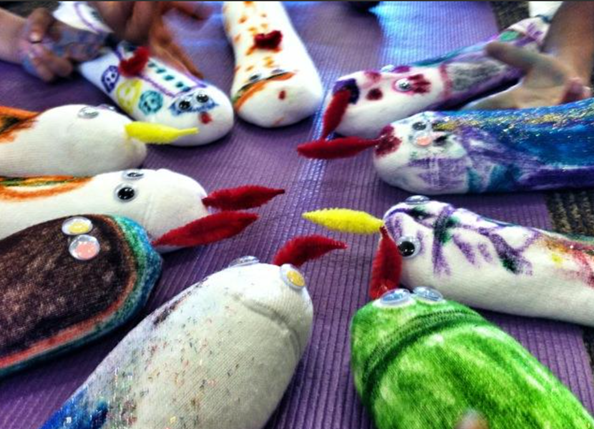
III. Art: The art project is based on the last pose of the class. The six-week program has six projects. There are chapters providing clear instructions.
IV. Yoga Part 2: The second yoga practice begins with the pose of the day, now with the art at the front of everyone’s mat or carpet square.
V. The Goodbye Song: Class ends by engaging each child as you continue to build social connection and body awareness. The Goodbye Song has the same format as the Hello Song.
Beginning with the same invitational question provides structure and consistency to ease the potential stress of transition times: “What yoga would you like to share with someone this week?” Sometimes it can be useful to say, “Let’s go around our circle (or the room). When it’s your turn, you may like to share. But today may not be a day for that.”
Connecting through Song: Now it’s time to sing the Goodbye Song. Again, the goodbye song can be as simple as: “Marcos, what would you like us to do as we sing – snap or quiet claps? “Goodbye, Marcos. Goodbye, Marcos. Goodbye, Marcos. Were glad you came to yoga.” If a child leaves early, it builds social connection to pause and sing the Goodbye Song to them. It is important for everyone to feel seen and to feel acknowledged as part of your group.
The book gives detailed templates and instructions for the art and yoga components. It includes Shanti coloring sheets and audio/video/handouts to share.
Have fun exploring all the possibilities!
You can read more about Children’s Art and Yoga for Autism and Diverse Abilities by Yael Calhoun here.