Queer Healing with Katy Lees and Lucy Fox
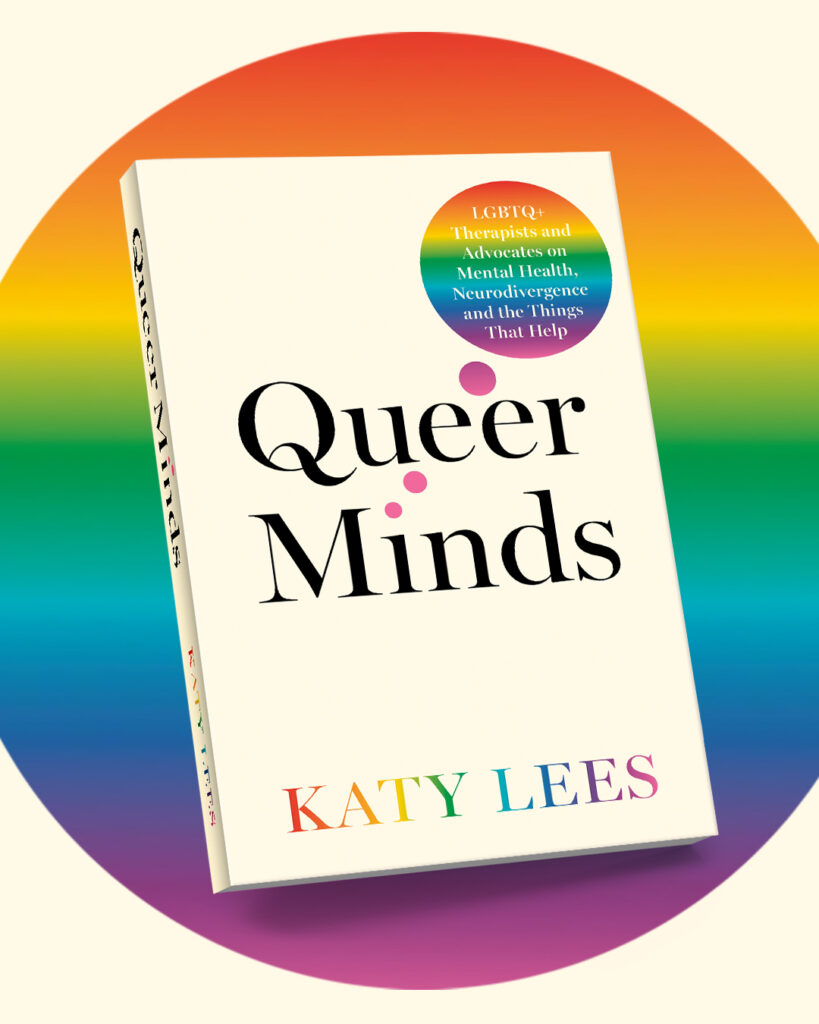
This is an extract from the chapter ‘Queer Healing with Lucy Fox’ of Queer Minds by Katy Lees.
Katy: So, you were a queer, trans, neurodivergent person coming of age in the 1980s and 90s. What was that like for you?
Lucy: For me, it kind of came in two flavours. There was not much positive LGBTQ+ representation around me, in particular for trans people. Gay people were described as people to avoid, because they were thought to be predators. Being queer had that societal feel of being terrifying, especially with people being murdered and beaten left, right, and centre for being gay.
But as an individual who didn’t particularly present as gay, or at least wasn’t ‘clocked’ until my teens, it was pretty inconsequential until it affected me directly. It affected me basically from high school onwards, which is why I didn’t attend my last two years – it was a dangerous, scary place. Being seen as queer made me such a huge target and, being someone who was clocked as queer in those days, people would not come to your defence. It was a very lonely and scary time growing up in terms of sexuality and gender, which caused me to repress a lot of my sexuality, and my gender as well.
Katy: I remember being a kid in the 1990s and ‘gay’ being the ultimate slur on the playground.
Lucy: It was very much like that. That doesn’t seem to have changed too much between our two generations (Gen X and millennial). Online, now, it still seems like ‘woke’ and ‘trans’ are some of the ultimate insults. What was I called the other day? ‘A liberal lefty snowflake.’ I guess gayness is still implied there as an insult, but maybe it’s not as predominantly dangerous as it was in my time, or your time.
I think that’s changing, especially as now you tend to find that gay children will have more chance of having a social group of their own who will stick up for them and use their voices, which is something you would never see in my day, at all, ever. I think that would probably not have been likely in your day, either?
Katy: When I was a kid, I didn’t have many friends. I had a lot of f iguring out to do as a kid about my gender and my sexuality, mostly because of societal stuff, like living under Section 28 (a law in effect from 1988 to 2003 in England, Scotland, and Wales that made ‘promoting homosexuality’ illegal in schools, meaning LGBTQ+ identities and lives could not be discussed and supportive LGBTQ+ literature was banned), and the general homophobia and trans hostility of the time. I did have a few friends, though, and as an adult, all of those friends have turned out to be queer in some way. So it’s interesting, because I feel like I did have a queer social circle, but none of us knew, none of us were out. None of us had figured that out when we were all hanging out, but we still somehow came together. I am hoping that – and it seems like – young people today have more of a chance of having an out and supportive queer social circle.
Lucy: I absolutely agree. I think going back to my school years, there weren’t queer circles. Groups were divided in different ways – the cool kids, the not-so-cool kids, the poor kids and the council estate kids, the swots, it was all that kind of thing. There was never a sexuality divide because people did not admit to it and, if anyone looked, acted, or said anything that could be construed as gay, it was a target on your back. Being perceived as gay was something all the kids could rally around, even the groups who hated each other. It was not fun being the rallying cry for the violence of an entire school. [Lucy laughs sadly]
Katy: No, it never feels good to be the pariah.
Lucy: Especially when even teachers pretend not to see things because you’re the queer kid. I imagine it’s easier to keep the school as a whole under control when you’re not protecting the pariah. Teachers don’t want to give up that control.
Katy: It’s classic scapegoating.
Lucy: ‘Let’s not admit our mistakes – we’ll point at the queer kid, instead.’ Or I suppose, these days, it’s the trans kid. [Lucy starts leaning away from the camera, out of view]
Katy: Sure. Speaking of, I – oh, where have you gone? Are you okay?
Lucy: [Lucy’s head pops back into the frame. She’s rubbing gel on one arm] I’m sorry, I forgot to put my hormone gel on this morning and this reminded me. I do apologize.
Katy: No, it’s okay!
Lucy: The privileges of being a transfem.
Katy: I’m absolutely going to put this in the book. This is gold.
Katy Lees is a queer, non-binary, person-centred therapist, primarily working with trans, non-binary and gender non-conforming clients. They have written on mental health, sexuality, relationship styles and trans life for publications such as Dirge Magazine, Do Some Damage, The Body Love Box and have appeared on podcasts such as Friend of Marilyn and the Trans Variety Hour. Katy is based in Hartlepool, UK.
Queer Minds is available as paperback and eBook on the 21st of November 2025.