Who Benefits from Blaming Parents & Carers of Autistic Children?
By Alice Running, author of We Need to Talk About Autism & Parent-Carer Blame, the first book tackling the issue of parental blame within autistic families head on.
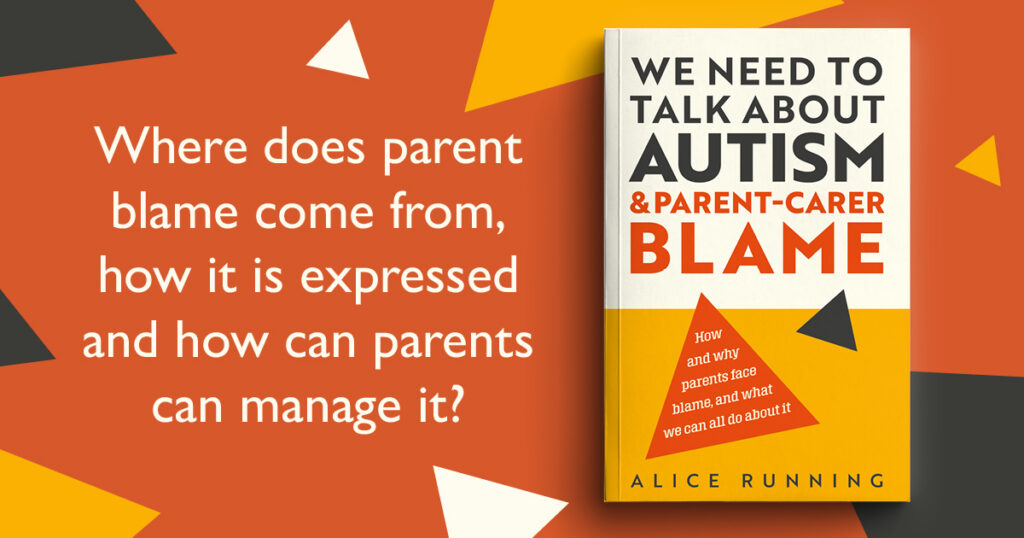
Parent-carer blame is pernicious and obstructs access to good provision and support for autistic children.
Parent-carers are told they are imagining their children’s needs – told they are causing harm to their children by asking for help; categorically told that their children are not autistic and the problem is their parenting. Reported to children’s services. Ostracised from local communities. These are some of the experiences that parent-carers of autistic children face when advocating for their children’s basic rights – access to education and healthcare.
We know this type of experience is occurring for autistic children nationwide because hard data tells us it is. In 2023, Danielle Jata-Hall (PDA Parenting) and I surveyed over one thousand parents of autistic-PDA children. 88% of our surveyed parents had experienced parental blame in lieu of effective provision or support. Parent-carers told us how they were gaslit, sent on parenting courses, disbelieved, threatened with safeguarding measures and refused effective support. Simply, autistic ways-of-being were repeatedly misunderstood or viewed as problematic ‘behaviour’ by involved professionals, with parents being viewed as the cause of the perceived issue.
Worryingly, our survey data suggested that certain types of parent-carers were more susceptible to serious aspects of parent-carer blame – lone mothers, or neurodivergent mothers were seemingly more likely to be subjected to safeguarding procedures than the rest of the survey population. This particular finding fits with what I have experienced myself.
As a lone autistic mother to autistic children, my attempts at navigating systems of support have brought me into direct contact with parent-carer blame. I know first-hand how distressing it is to be told you are harming your children when all you are doing is advocating for the right education package or explaining how autistic-ways-of-being must be accurately understood.
Yet many professionals view parental advocacy as obstructive, failing to respect parental expertise as valid. Preferring instead to push outdated views of autism as needing management or treatment; to mould autistic children into non-autistic ways-of-being so they fit into existing systems, rather than consider the existing systems as harmful to autistic children. Similarly, the failings of the ‘SEND’ system itself are obscured by those service professionals who blame parents for system-failings, to either avoid accountability or protect limited funding.
But of course, blaming parents of autistic children for ‘autism’ itself runs much deeper than the protection of a sinking ‘SEND’ system. From the conception of autism as a clinical diagnostic category, parents have been blamed, with ‘autism’ viewed as a disease to be cured or as a ‘bad’ thing that invokes pity at best. Attitudes such as these underpin our cultural positioning of ‘autism’, in turn impacting how autistic people and their families are viewed in their everyday lives. We only need to take a passing interest in current news to recognise that autistic people and their families are still being blamed for either sapping the welfare state of funding or causing ‘epidemics’ of ‘autism’ by ingesting paracetamol. It matters less how provable these ‘revelations’ are because the narratives they convey are designed to position autistic people outside of their own communities; to separate autistic people from non-autistic people and blame them for societal problems.
I strongly believe in the power of autistic storytelling in countering the dehumanisation of autistic people. And in ‘We Need to Talk About Autism and Parent-Carer Blame’ I share my own accounts of being blamed by neighbours, ostracised by community and scapegoated as the cause for ineffective ‘autism’ understanding. I share my story alongside other parent-carers who bravely recount their experiences of being blamed by an inflexible and outdated education and health care system.
Together, our voices demonstrate the human cost of blaming parent-carers for their autistic children’s ways-of-being. The accumulated trauma for families is often unsurmountable. Lives are changed beyond recognition. Parents and their children are left with long-term anxiety or trauma; family finances and relationships are destroyed. It is important that society understands what parent-carer blame does; it destroys lives and prevents children from accessing the world on a par with their non-autistic peers.
The experiences of those families who have experienced blame are helpful for other families experiencing similar. ‘We Need to Talk About Autism and Parent-Carer Blame’ utilises such experience to offer grounded advice for other parent-carers of autistic children. But further, suggestions for professional practice – suggestions that are grounded in autistic insight – are offered.
‘We Need to Talk About Autism and Parent-Carer Blame’ restores respect for both autistic and parental expertise and in doing so, offers a roadmap towards better understanding of autistic ‘need’ – one in which families are not blamed for systems failings.
Alice Running is an autistic woman and parent to two neurodivergent children. Alice holds a PgC in Autism and has articles published in The Mighty, Yahoo, Special Needs Jungle, Huffington Post, Yorkshire Evening Post and The Big Issue in the North.