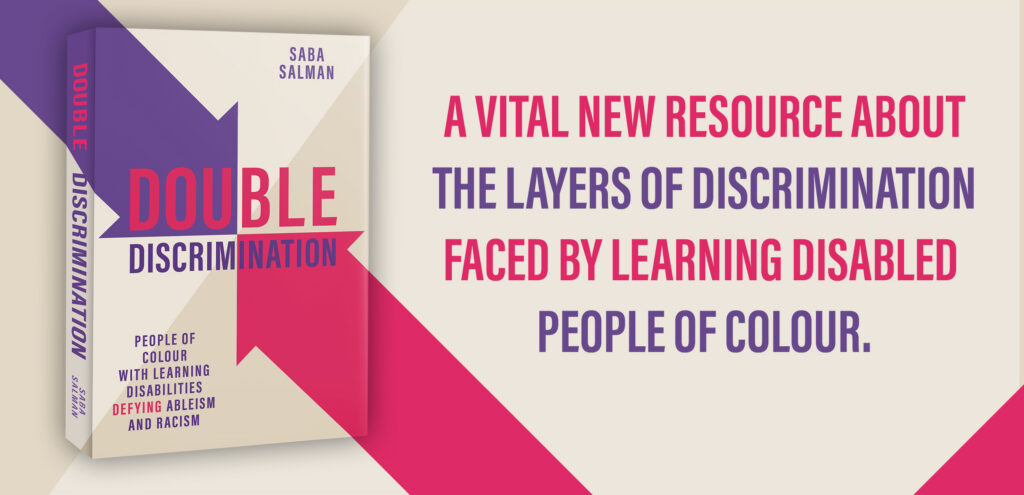
Three truths about the history of racism and learning disability
By Saba Salman, author of Double Discrimination.
Saba Salman is an author, editor and award-winning social affairs journalist writing on diversity, learning disability and autism. Her sister, Raana, has the learning disability Fragile X syndrome and influences her work. Saba edits the learning disability magazine Community Living, chairs Sibs, the national charity for disabled people’s siblings, and is an ambassador for National Development Team for Inclusion.
How have attitudes towards learning disability changed over time? Where – if at all – do historical ideas about race fit into this?
I explore these questions in Double Discrimination, a book on the inequalities faced by learning disabled people of colour, like my sister Raana.
‘We need to talk about learning disability and race because they’re deeply entangled concepts,’ historian Simon Jarrett explains in Double Discrimination, ‘but we’re not aware they’re deeply entangled concepts and they’re embedded deep within all of us.”
Understanding approaches to learning disability today rests partly on learning about approaches of the past; Double Discrimination reflects three broad historical themes relating to racism and abelism.
1. The excluded were once included
In contrast to how modern society distances learning disabled people – around 2,000 are locked away in secure institutions – ancient communities were more inclusive.
Take the news in 2024 that a fragment of bone discovered in a Spanish cave belonged to a Neanderthal child thought to have Down syndrome. At face value, that finding suggests inclusion.
Fast forward to medieval times and most learning disabled people lived with their families. Some lived on the streets and begged, a few worked as ‘natural fools’ in the royal courts, some were sheltered in convents and monasteries.
People were known to their communities until the early 19th century, when the Enlightenment changed everything. The era brought values of reason and human rights which supported an inclusive approach, but its focus on body, science and medicine also triggered a more medical approach to disability. People were seen as unproductive and undesirable, and the state’s job was to contain and control them.
2. There’s a false link between intellect and ethnicity
As for control, the growth of the British empire brought the idea that people who were not white were uncivilised, unintelligent and needed authority.
You can see this conflation of race, ethnicity and intelligence in the work of Dr John Langdon Down (who later gave his name to Down syndrome). Keen on the Victorian love of classification, Langdon Down ran Earlswood in Surrey, the first purpose-built learning disability institution. He studied his inmates’ faces, aligning them with racial classifications of the time. He wrote a paper on this ‘ethnic classification’, arguing that his asylum contained the world’s five races, in ascending order: the Aztecs, Ethiopics, Mongols, Malayans and Caucasians. Today, we’d regard this as racist; in the mid-nineteenth century it simply reflected prevailing attitudes.
The association between ‘race’ or ethnicity and inferior intellect is clear in the term ‘colonies’ – institutions that grew from the late nineteenth century. These self-contained developments were built in isolated areas and held up to 1500 people.
Soon, eugenics took off, ‘the science which deals with all influences which improve the inborn qualities of a race’, according to its originator Francis Galton (as Charles Darwin’s cousin, Galton was influenced by his relation’s theory of evolution). Eugenicists argued sterilisation would cleanse ‘defectives’ from the gene pool – people who today we’d describe as having learning disabilities. This path of thinking led the Nazis to their national policy of eradicating such ‘useless eaters’.
Eugenics dwindled with the post-war focus on human rights, but the idea that people with learning disabilities were second class citizens was harder to shift. In the 1940s, children with special educational needs were categorised by their disabilities, some labelled ‘uneducable’ or ‘educationally subnormal’ and segregated in separate schools. The link between dark skin and inferior intellect was so fixed that Black children without learning disabilities were wrongly labelled as subnormal and moved to special schools.
By the 1950s, colonies were rebranded as ‘long stay hospitals’ and standard medical advice for parents of learning disabled children was to hospitalise them – and forget them.
While 1980s ‘care in the community’ shut down most long-stay institutions, a restrictive, institutional-style approach is apparent in some community-based support for learning disabled people. Look no further than the well-documented learning disability care scandals.
3. The fight for rights has firm roots
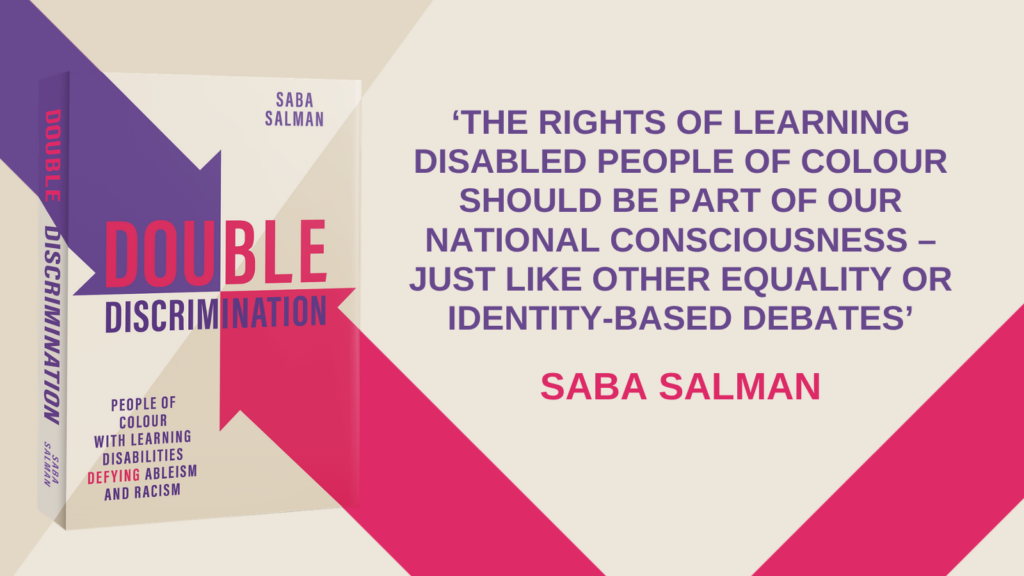
Double Discrimination reveals not just the social injustices experienced by people like my sister, but how campaigners are leading the fight to right these wrongs.
The roots of adovocacy include the 1980s campaign for equal access to education, and the parents who founded charities like the National Autistic Society.
Influenced by American disability and civil rights movements, self-advocacy grew in the UK.
Although disability and race equality are distinct movements today, the two came together during the 504 sit-in. This month-long occupation of a San Francisco federal building in the 1970s forced through civil rights protections for disabled people and was supported by the Black Panthers. Two discriminated against groups collaborated, their success paving the way for the 1990 Americans with Disabilities Act.
As for UK policy, Double Discrimination explores the unfulfilled hope of the government’s 2001 rights-based national learning disability strategy. Although well-intentioned, it is now 25 years since the policy was published – the lack of progress since is the cause of much frustration.
Our society’s treatment of learning disabled people is the story of how we’ve moved from community to containment. Historical attitudes are hard to stomach, but if we’re to see people like my sister today, we need to see how they have been treated in the past.
Today, activists standing on the shoulders of those who came before them urge us to join in their movement for justice. You can read more from them in Double Discrimination.
Double Discrimination is publishing 21st May 2026. You can view the book film below. This features some individuals whose stories are included in the book such as researcher Paul Christian, pianist Chapman Shum and Bollywood dancer Harry Cartmill.