Viv Dawes, autistic advocate, on masking and burnout
Viv Dawes is the author of The Young Person’s Guide to Autistic Burnout. Viv is an autistic and ADHD lived experience advocate, writer, public speaker and trainer with over 25 years experience working with vulnerable neurodivergent people, including as a Senior Practitioner in the NHS. Viv regularly delivers training for various organisations including the YMCA and CAMHS and started the Autistic Burnout Network. www.autisticadvocate.co.uk
Lots of people think they understand what masking in autistic people means, but they
often don’t appreciate the links between masking and the nervous system. In my book
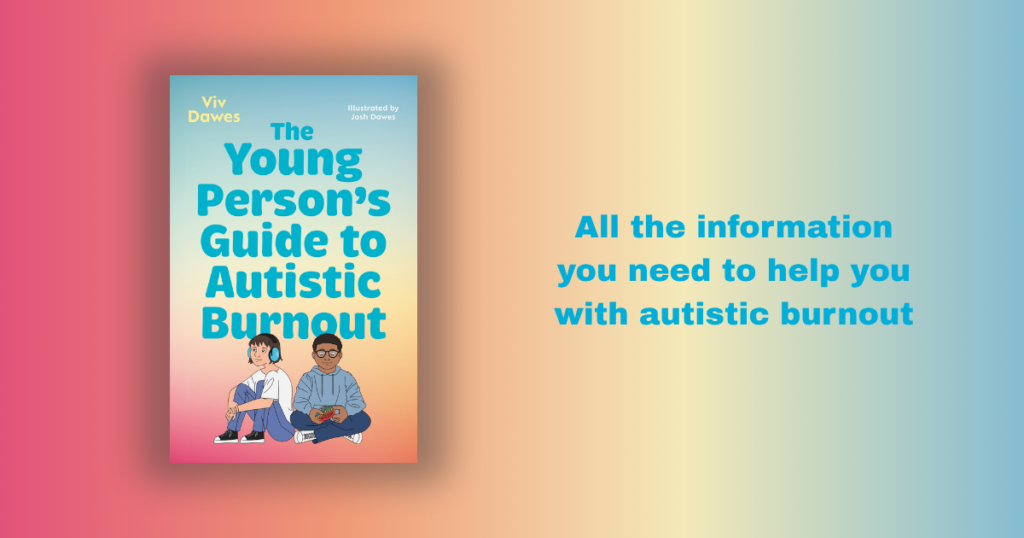
‘The Young Person’s Guide to Autistic Burnout’ I wanted to help autistic young people
(whether diagnosed or not) understand autistic masking, how exhausting it is and why it
can be one of the main causes of burnout.
Masking in autistic people is often subconscious and mostly governed by our more
sensitive nervous system, particularly the autonomic nervous system. Environments
that are not ‘safe’ for us, meaning that they are not in sync with our differences and
different needs, will trigger a trauma response. Those trauma responses such as fight,
flight, freeze and fawn (there are also others such as flop and funster) are triggered in
any situation when we feel threatened, in danger and unsafe. School environments are
sadly often unsafe for autistic children, especially secondary school. And that is
because the system is fundamentally designed for neurotypical people, and not
considerate of the sensory, executive functioning, emotional, communication and
social needs of autistic children.
Research carried out by cognitive neuroscientist Dr Sinead Mullally and her team in
2023, where they interviewed 900 parents of children displaying school based distress,
found that over 83% of children experiencing school distress/ trauma are autistic! This
statistic should make us sit up and rethink the environments we create for all children
and young people. Many autistic children go unidentified for years due to masking
because the fact is that so often schools do not understand the true nature of masking
and the impact upon mental health – impact that can last a lifetime. Parents of distressed
autistic children (often unidentified) are too often told by schools that their child is ‘fine’
when they are at school – they are well behaved, quiet, they have friends, they give eye
contact, they do their work, they are compliant. Compliance can be a sure sign of
fawning – masking. A young person going along with things to please others without
expressing or even knowing how to explain their distress (until it explodes in a meltdown
at home) looks like a child/young person who has their needs met in school. Except
that their needs are too often not being met in school because underneath the surface
they are struggling to the point of collapse. Out of those 83% of autistic children and
young people experiencing school-based trauma, I wonder how many are experiencing
burnout? I would confidently bet that most of them are and that they are exhausted by a
system that does not see them, hear them or understand them.
So why does masking lead to burnout in autistic people? Because all that hiding in plain
sight, which Dr Wenn Lawson describes as ‘adaptive morphing’, is completely
exhausting. Being hypervigilant and in fight or flight mode for prolonged periods of time
means a lot of cortisol being pumped around your blood stream. Too much cortisol can
lead eventually to exhaustion and fatigue. Fact.
In order for environments and the systems within them to be and feel safe for autistic
children and young people, we have to break down the stigma that is still
surrounding autism and ADHD, too. For example, by the time an ADHDer is 12 they will
have had 20,000 more negative things said to them and about them. This is important
because possibly as many as 80% of autistic children are actually AuDHD
(autistic/ADHD). And did you know that the word ‘autistic’ is used as an insult or slur amongst many
children and young people? When they are so often the target of ridicule and too
often bullied and victimised, is it any wonder autistic people are so hypervigilant and
hide – knowingly or unknowingly?
In my book for young people I also talk about masking as suppressing distress caused
by sensory issues or even pain that is not believed by professionals. One of the
characters in my book, Luna, talks about not being able to be themselves, “Hiding who I
really am and holding everything in is just so exhausting, because it takes so much
effort to do all the things people expect, like giving eye contact, joining in with small talk
(yuk!) and putting up with sensory stuff. Not being able to talk loads about the things
that really matter to me and having to stop myself stimming is all so draining. It actually
hurts me.”
I wrote ‘The Young Person’s Guide to Autistic Burnout’ because it’s so crucial that young
autistic people, whether diagnosed or not, understand why they are surviving,
exhausted and burnt out and what can help them to experience recovery. The book aims
to help them understand themselves and their needs better too – one of the keys to
potentially thriving as an autistic person.
The Young Person’s Guide to Autistic Burnout is available to buy now.