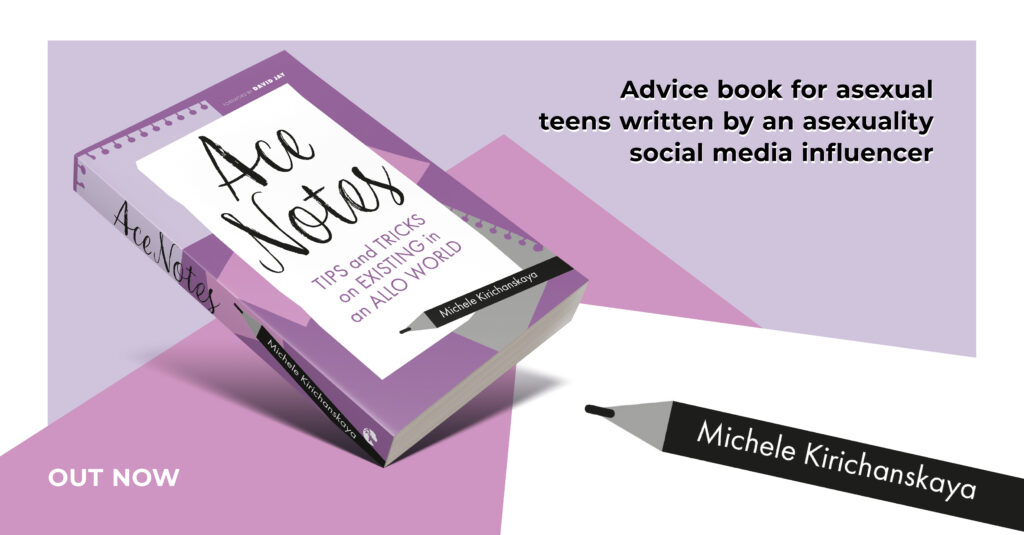
Notes on Being Ace, a sneak peek into Ace Notes by Michele Kirichanskaya
By Michele Kirichanskaya, author of Ace Notes, out now.
I think I first started to realize I was asexual when I was around the age of fifteen or seventeen. Back in high school, surrounded by mostly straight (or seemingly straight) classmates and media, I didn’t really connect to much of the hook-up culture I saw around me, whether in person or in mainstream media. (As a side note, it’s very concerning how much adult-made content about teenagers revolves aggressively around sex, but that’s a topic for another day.) Instead of actively looking for someone to make out or have sex with, for the most part I was content studying and geeking out with my friends over cartoons and comics.
But there was still a sense that something was “off,” that I wasn’t quite like everyone else.
Around the same time, some of the people around me had started coming out as queer or questioning their sexuality, which may have helped open up the idea that maybe my own assumed
“straightness” wasn’t so solid. And thanks to the likes of Google, I eventually stumbled across the word “asexual,” which, although I didn’t know it at the time, kind of changed my life.
Because as cliché as it might sound, coming across the word “asexual” and all its associated definitions and sublabels felt like something just clicked. As though there suddenly was a vocabulary
open to me that could help me name and define my own experi- ences. That helped me realize that I wasn’t alone in who I was.
But as I got older, I soon started to realize how much of an anomaly this was. Talking to other aces and reading accounts from aces online, I began to realize how many people didn’t come into knowledge of asexuality until later in life, and how many grew feeling alone, feeling “wrong” or “broken” for who they were. And it breaks my heart every time I hear about it.
No one should have to feel “broken” for being who they are.
I wish for so many of us that we could have vocabulary at an early age. That we understand there are multiple ways to exist in this world, including ways that aren’t defined by sexual attraction.
That we have the visibility and awareness that makes knowing and understanding asexuality that much more accessible. I want so much better for other aces. And I wanted better for myself, too.
While the 2010s were obviously not the darkest age for queer visibility, ace visibility was still pretty absent. When I first started getting into the realization that I was ace, BoJack Horseman and Todd Chavez (who, frustratingly, is still one of the only visibly, canonically asexual characters on television) wasn’t yet a thing, nor were there any characters on the big screen that I could relate to. As a teen, I scrolled through books, trying to find some literary semblance of who I was, to see myself reflected in the pages I loved. In high school, there was no mention of asexuality in the already rudimentary sex education we received, nor did I find any mention of it in the few Gender and Sexuality or Psychology courses I took in college. There was no specific guide to being asexual. No book on how to navigate coming out as ace, or what to do after encountering an acephobe. No mainstream article that went beyond the Asexual 101s of how asexuality means “little or no sexual attraction to others.”
Since realizing I was ace, I’ve felt I had to dig like an archaeol- ogist, scouring through lists and documents and archives to learn what I now know today.
I hope this book saves you some of that time, energy, and effort, and instead frees up space to learn more about yourself, including figuring out how to exist more comfortably as an ace in this strange, allonormative world.
Before moving forward, I should note a few things.
One, I want to make something clear. I am not a queer educator or a professor. I am simply an ace person who has some years of lived experience under their belt and wants to offer whatever insight they have that might make it easier for other aces who read this book.
Two, my perspective on aceness, just like my perspective of the world in general, is a limited one. While I may experience some forms of marginalization, because of the skin and body I occupy I do not have to face some of the
same prejudices or barriers to access and protection that other aces, such as BIPOC* aces, do. That is why I have invited other aces who have generously donated their time
to speak about their perspectives on the diversity and intersectionality found within the ace community, including speaking on subjects of gender, disability, race, faith, and more.
While not everyone who reads this book will find their specific experiences reflected
in it or resonate with every word written, I hope that what you might find in these pages will provide some sound advice and comfort. And I hope that this book will become one of many titles in the larger canon of ace literature, and that it will be joined by many other amaz- ing ace voices in the very near future. And who knows, maybe you’ll even be one of them.
* BIPOC: Black, Indigenous, and People of Color.
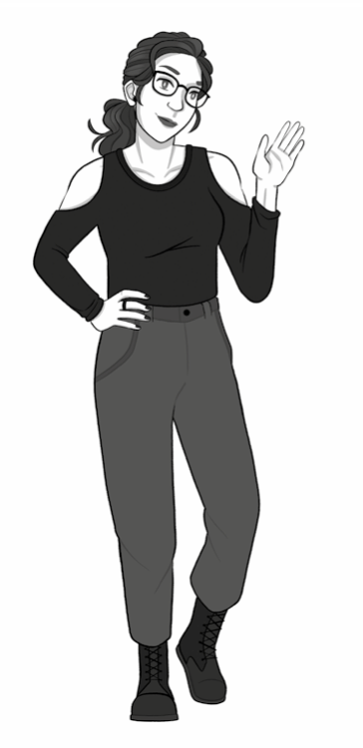
Michele Kirichanskaya is a first-generation Ukrainian Jewish American writer and journalist
born and raised in Brooklyn, New York. A graduate of the New School MFA Program and Hunter College, she has written content for platforms such as GeeksOUT, Catapult, Bitch Media, Electric Lit, The Mary Sue, and more. When she is not writing, she is reading, watching an absurd amount of cartoons, and generally trying to live her life despite its many interruptions. She is currently based in Brooklyn. Her book, Ace Notes, is available now.