We Were Raised to Burn Out: Helping Neurodivergent Kids Honour Their Energy
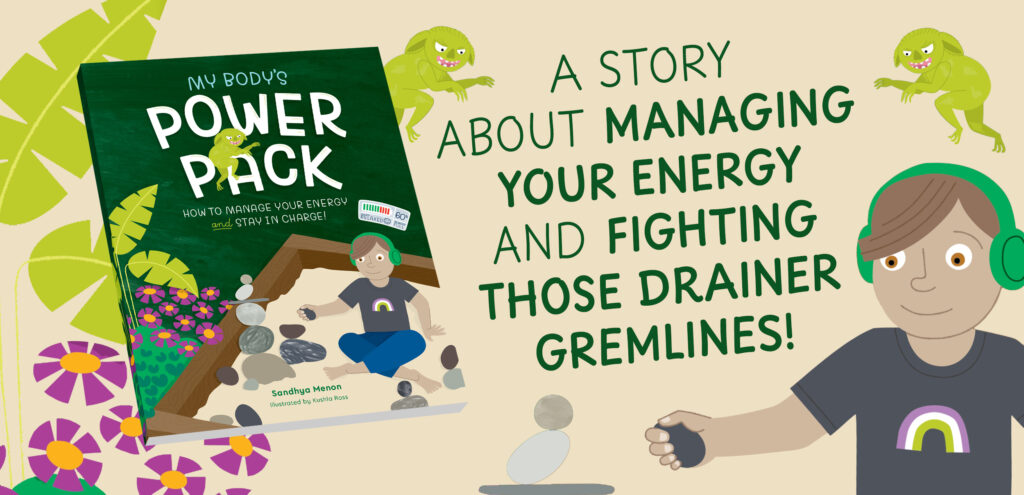
My Body’s Power Pack by Sandhya Menon
Burnout isn’t always a loud crash-bang, can’t-do-it-anymore, sleep-in-bed-for-days kind of thing.
Sometimes it creeps in. Quietly.
Like when you start cancelling plans – not because you don’t care, but because your body is whispering please, no more.
When the smallest things feel huge.
When everything starts tasting like cardboard, and even rest doesn’t refill the tank.
For Autistic and ADHD people, burnout isn’t a buzzword. It’s a deeply embodied reality. It happens right across the lifespan – from little kids before preschool to adults juggling work, parenting, or retirement.
Burnout doesn’t show up because we’re fragile. It shows up because of the world we’re navigating.
A world that demands consistency. That overloads us with lights, noise, expectations, and unspoken rules.
A world that doesn’t account for our intense wiring, our boom-or-bust rhythms.
That’s where energy accounting comes in.
What is energy accounting, really?
At its core, energy accounting is about noticing:
• What’s in my power pack today?
• What’s draining me?
• What helps me recharge?
The term builds on Spoon Theory by Christine Miserandino, adapted by Autistic psychologist Maja Toudal. It invites us to check in with our energy, rather than always responding to external demands.
It might sound simple, but in a culture that rewards pushing through, masking, behaving, and “trying harder,” it’s quietly radical.
Most of us weren’t raised to tune in to our energy needs.
We were raised to push through.
“Why can’t you do that? Just keep going”
To mask. To behave.
“It’s not that bad, you’ll be fine.”
To perform. To work harder. To keep up.
“You could do better if you tried harder. You have the potential”
And then, eventually, we were raised to burn out.
The problem with burnout as the norm
Before I began this work in the way I do now, I spent a lot of time supporting families through meltdowns. One of the hardest truths I learned was this:
By the time someone’s melting down, we’ve already missed a dozen signs.
A meltdown isn’t a behavioural problem. It’s a nervous system crash.
It’s trauma. It’s the body screaming after being ignored for too long.
Our systems tend to be reactive. We jump into action after things fall apart, rather than protecting energy before we reach the red zone.
Energy accounting changes that.
It’s preventative, protective, responsive.
It helps us ask:
What’s really happening in this nervous system before it screams?
We’re still learning
Some people naturally live in a way that protects their energy.
They say no without guilt. They rest without apology. They build lives that don’t run on fumes.
I admire that.
However, for many of us, this is a process of unlearning. We unpack old stories and learn to listen to our bodies in a new way.
As an Autistic ADHDer adult, I’ve had to build my own energy framework from the ground up. I’ve run on empty more times than I want to admit. Through the Very Hard Way, I’ve also learned how to pause and ask:
• What feels like a full-body “no” today?
• Which relationships energise me?
• Have I eaten? Rested? Had silence? Had joy?
• What can I say no to?
Bit by bit, I’m curating my own anti-burnout plan for life, one that’s rooted in sustainability, not survival.
Why kids need this too
One of the reasons I love working with children is because we can set them up before the crash and before burnout becomes their baseline.
If we teach kids to recognise their energy, to track their power packs, to name what fills and drains them, we give them what many of us only found in adulthood.
Tools that say:
Your needs matter.
Your body is wise.
You are allowed to rest before you break.
That’s exactly why I wrote My Body’s Power Pack.
It’s not just a book. It’s a framework. A conversation starter. A visual, playful way to help kids (and their grown-ups) map out:
• What boosts their power pack
• What zaps their energy
• How they can communicate their needs with confidence
When kids grow up fluent in this kind of emotional literacy, we raise neurodivergent adults who are attuned, self-respecting, and resilient.
The invitation
Whether you’re a parent, professional, or fellow neurodivergent human trying to avoid your next burnout cycle, here’s what I want you to know:
Energy accounting isn’t selfish.
It’s not indulgent.
It’s necessary self-care.
So let me ask you:
What’s something you’ve uncovered about your energy lately?
What’s one tiny tweak you could make to protect your power pack today?
Because the more we share, the more we remember:
We don’t have to figure this out alone.
Want to dive deeper into energy accounting with your child (or your inner child)?
Explore My Body’s Power Pack – a gentle, playful guide to helping neurodivergent kids understand, protect, and honour their energy.
To a world where burnout isn’t the norm.
Where we grow up fiercely protective of our nervous systems.
Where neurodivergent adults are wired to not just survive, but thrive.