Why ADHD Is Not “All in the Head”: The Gut, the Nervous System, and the Signals We Feel
By Dr Miguel Toribio-Mateas CBiol, Clinical Neuroscientist and author of ADHD Body and Mind.
Dr Miguel Toribio-Mateas is a clinical neuroscientist, nutritionist, and applied microbiologist with a doctoral degree in Gut Microbiome & Mental Health.
When people think about ADHD, they usually think about the brain. They think about attention, distraction, impulsivity, overwhelm, and executive function. They may also be thinking about missed deadlines, thoughts racing, and the struggle to stay on top of everyday life. What they do not usually think about is the gut. And yet, if there is one thing I hope readers take from ADHD Body and Mind, it is this: ADHD is not just a brain-based experience. It is a whole mind-body experience. In many ways, that became my mantra while writing this book.
That does not mean ADHD is caused by the gut. ADHD is a neurodevelopmental condition with deep biological roots, and what happens in the gut can still influence how you experience it in daily life. Gut health can affect your sensitivity to stress, your ability to regulate your emotions, your energy and focus, and even how safe or unsettled you feel in your body. And this is not fringe science. It is part of a growing body of research on the gut-brain axis, the constant two-way conversation between the digestive system, the nervous system, and the brain.
One of the reasons this matters so much is that many ADHDers do not simply struggle with attention. We also struggle with regulation. We can feel too much, too fast. We can go from calm to frazzled in minutes, sometimes seconds. We can miss our body’s cues when we are absorbed in something, then suddenly crash, hungry, shaky, irritable, and emotionally raw. For many of us, the issue is not just what we think. It is what we notice, what we miss, and how the body communicates with the brain.
This is where interoception comes in. Interoception is your ability to sense what is happening inside your body. It is how you notice hunger, fullness, nausea, butterflies in your stomach, a racing heart, or the first signs that you are getting dysregulated. It is your inner sensory system. And for many neurodivergent people, this system can be a little noisy, a little muted, or simply inconsistent. You may not realise you need the toilet until it is urgent. You may forget to eat, then feel suddenly overwhelmed and not understand why. You may think you are anxious when what is actually happening is that your blood sugar has tanked, your digestion feels off, or your nervous system is already running too hot.
This is one of the reasons I am so interested in the gut-brain connection in ADHD. Not because I believe there is a miracle food, or a magic probiotic, or a single pathway that explains everything. There is not. But because the gut is one of the places where body signals are generated, interpreted, and relayed. It is part of the conversation.
The gut has its own nervous system, the enteric nervous system, and it communicates with the brain largely through the vagus nerve. In fact, a large proportion of the signals in this system travel from the gut upwards to the brain, not the other way around. That means digestion, microbial activity, inflammation, and the overall state of the gut can all influence how the brain responds to stress and how the body feels from within.
So when your gut is unsettled, your body may read the world differently.
You may feel more reactive, more fragile, less buffered. You may find it harder to tolerate frustration, shift gears, or recover after stress. If your digestion is erratic, your meals irregular, your nervous system overloaded, and your internal cues difficult to read, it makes perfect sense that ADHD can feel harder to carry.
Please let me assure you that this is not about blame. I don’t intend to tell people with ADHD to “fix their gut” as though that will solve everything. That kind of thinking is simplistic and quite possibly harmful because it ignores your history, your trauma, your context, the way that medication affects you, your sensory needs, your executive function barriers, and the realities of your everyday life.
It is also why I am not especially interested in reducing this conversation to dopamine or serotonin. Yes, dopamine is a key neurotransmitter in ADHD and it can be a little “glitchy” for most of us ADHDers, whether on meds or not. And yes, most of the body’s serotonin is produced in the gut, and the microbiome plays a role in how the nervous and immune systems talk to each other. But focusing too narrowly on one neurotransmitter can make the whole thing sound more tidy than it really is.
The real story is more interesting than that.
The gut-brain axis is not about one isolated molecule, but about relationship. It is about how the foods you eat, the stress you carry, the rhythms you keep, and the signals your body sends all become part of the wider landscape in which ADHD is lived. It is about the fact that your body is not separate from your mind. Your digestion is not separate from your mood. Your ability to cope is not separate from what is happening in your body. This is why you’ll often hear me say that food is much more than fuel. It is information, comfort, and sometimes even a form of love. It is no surprise, then, that we may turn to it for soothing when we feel dysregulated and have few other supports in place.
A meal can anchor you, but it can also destabilise you. Eating too late, too little, or too chaotically can make everything feel louder. On the other hand, regular nourishment, enough fibre, more plant diversity, fermented foods when tolerated, and a gentler rhythm around food can help create more stability. And I’ll say this once now, but I’ll repeat it a thousand times throughout my book. The aim is not perfection, but continuity and stability.
And perhaps that is the most important point. If you live with ADHD, your goal does not need to be to become a different kind of person. It is not about forcing yourself into someone else’s idea of ideal eating or perfect self-regulation. It is about learning to read your own signals with more kindness and less shame. To notice that sometimes what feels like irritability is actually hunger. That what feels like emotional chaos may be sensory overload plus poor sleep plus a gut that is not happy. That what looks like “being bad at life” may simply be a nervous system asking for support.
Because ADHD is not all in your head. It lives in your rhythms, your stress responses, your body cues, your digestion, your breathing, your energy, your history.
And when we start to understand it that way, something softens. We stop asking, “What is wrong with me?” And we begin to ask, “What is my body trying to tell me?”
I believe that is a very different question. And a much kinder place to begin.
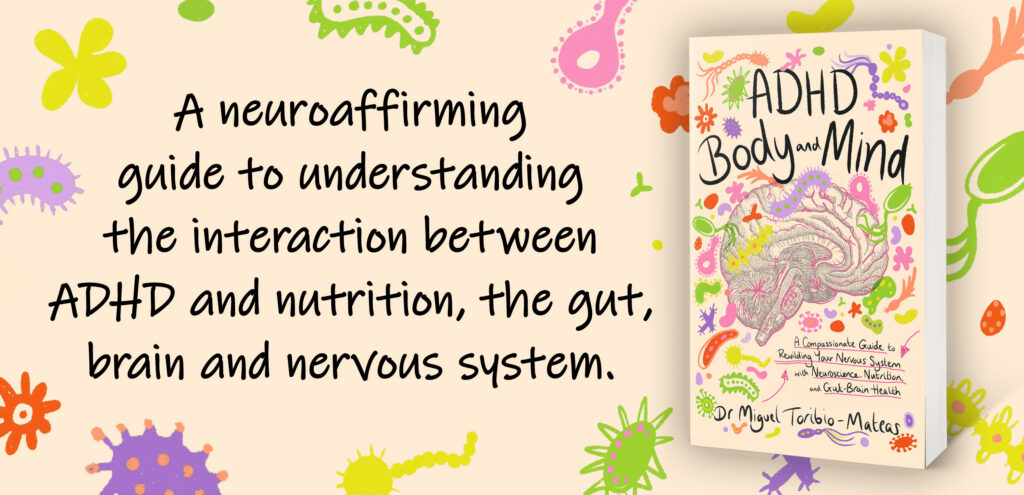
If this way of thinking about ADHD speaks to something you recognise in yourself, I explore these ideas further in ADHD Body and Mind, through the wider story of the body, its rhythms, and lived experience.
With love,
Dr Miguel ♡