Identifying Emotional States: Extract from Working with Autistic People in Mental Health Settings
By Dr Anna Day. This text has been adapted from section 6.4.1 ‘Identifying Emotional States’ of Working with Autistic People in Mental Health Settings, which is available to purchase here.
Coming from compassion-focused therapy, Gilbert’s (2010) evolutionary model describes three motivational systems to explain emotions in terms of their evolutionary function, each associated with different feelings and behaviours:
Threat
Threat relates to how we respond to potential danger. The body prepares us to run away, fight, etc., resulting in uncomfortable and unpleasant sensations such as sensory changes, feeling lightheaded, increased heart rate, tense muscles. Attention shifts to our surroundings to scan for possible threats, which makes it difficult to concentrate when we are highly anxious. Threat mode may be provoked by sensory overload, such as too much noise or light. Given that many Autistic people have sensory processing differences, it is not surprising that many experience anxiety or distress.
There are a range of automatic responses:
Flight: An overwhelming urge to escape the situation. Escaping is not always possible (e.g., the person may be unable to walk out of a meeting in the workplace) and so these urges might be expressed in other ways such as pacing, foot tapping. The person might also try to hide or back away from the threat.
Fight: Physically fighting, pushing, struggling, resisting verbally, or behaving aggressively.
Freeze: Going tense, still, and silent as an instinctive survival response. Freezing gives time to evaluate a situation and if it is not possible to escape a situation, becoming unresponsive might be the best chance for survival.
Flop: Similar to freezing, except muscles become loose and the body goes floppy. This can reduce the physical pain of what is happening, or the person’s mind can shut down to protect itself.
Fawn: If the threat is from another person, adopting submissive body posture, placating, or submitting can reduce the danger, even if it means we say or do things we later regret.
Drive
The force that motivates and moves us towards what we want and desire.
Soothe
The balancing system that improves our capacity for self-compassion/ support and alleviates the deleterious effects of stress.
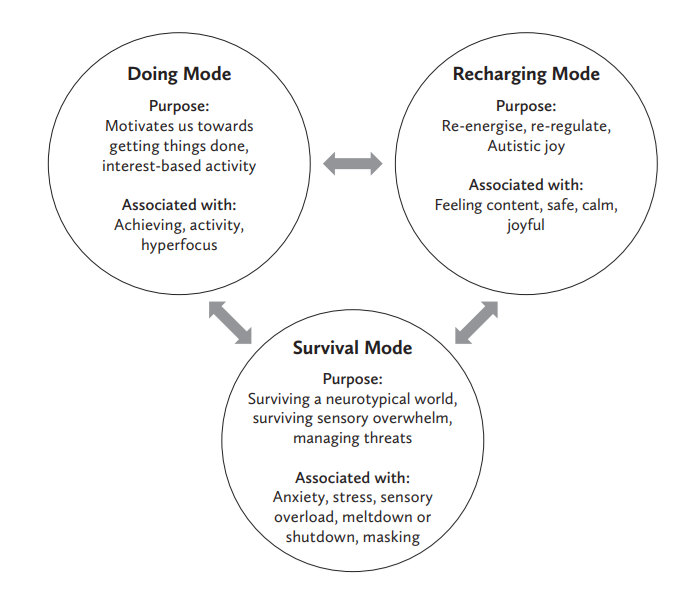
On the following page is a version of Gilbert’s model adapted for Autistic experience as a resource to use with Autistic clients (see also Appendix B). In this, Threat is ‘Survival Mode’, Drive is ‘Doing Mode’, and Soothe is ‘Recharging Mode’.
Survival Mode
In Survival, the fight or flight response is dominant. The focus is surviving not only the stress and threats that people of all neurotypes are faced with, but also the additional (and often chronic) stresses associated with being Autistic in a world not designed for our neurology.
Many Autistic people can end up being in an almost constant state of Survival, arising from being bombarded with sensory information, constantly being exposed to a narrative of deficit, threats to Autistic identity, and being misunderstood.
Unsurprisingly, masking is used by many Autistic people as a survival strategy, even though masking does increase the likelihood of meltdown, shutdown, or Autistic burnout.
If someone is in Survival Mode and completely overwhelmed, it is not a good time to attempt tasks that require the ability to focus and multi-task. If your Autistic client is predominantly in Survival Mode, then working towards therapeutic change is neither appropriate nor likely to be successful.
Doing Mode
Doing Mode is focused on getting things done and achieving. It is only possible to be in Doing Mode if the person has sufficient energy resources and is not being overwhelmed by sensory information, etc. (which is likely to trigger Survival Mode). Hyperfocus can mean an Autistic person may be exceedingly driven in getting a specific task done, but it often means that other ‘life admin’ can drift and can end up being painful and tiring.
Recharging Mode
Everyone needs to have time to rest, be soothed, and recharge, but Recharging is critical for Autistic people. Recharging’s vital importance for Autistic well-being can be misunderstood by non-autistic people. Engaging in passions can help the person rest and re-energise.
It can take Autistic people much longer to recharge than non-autistic people. Not only do they have less energy resources to start with (see Section 6.3), but those resources get used up quicker by everyday tasks and are constantly being drained by incoming sensory stimuli.
Managing Doing and Survival Modes is much harder when insufficient time is spent in Recharging Mode.
Dr Anna Day is an Autistic and ADHD Principal Clinical Psychologist at The Adult Autism and ADHD Practice, Dublin. She co-authored The Adult Autism Assessment Handbook and The Neurodiversity Affirmative Child Assessment Handbook and advocates for neurodiversity-affirmative practice within mental health care and education. Her new book, Working with Autistic People in Mental Health Settings, is available now.