Using Stories to Help Children Understand Emetophobia
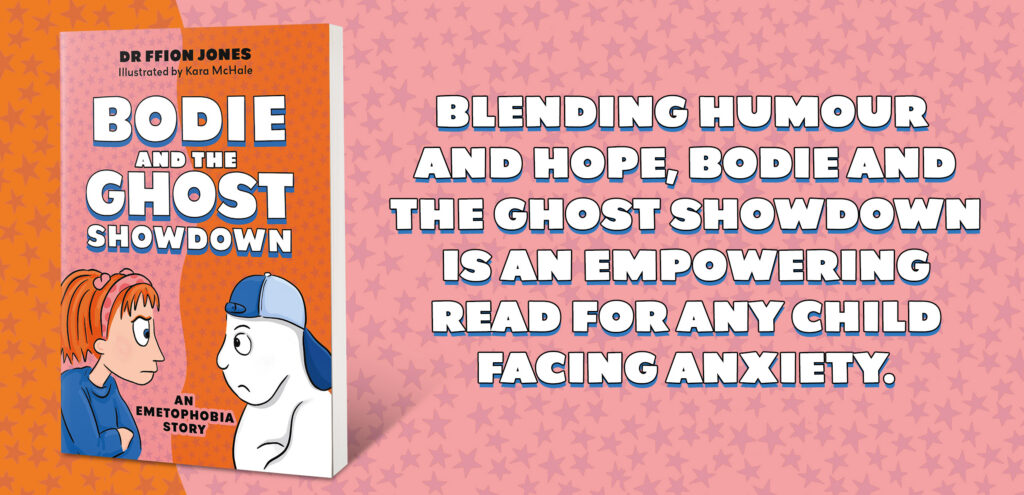
By Dr Ffion Jones, author of Bodie and the Ghost Showdown.
Dr Ffion Jones is an author and illustrator. She works as an emotional wellbeing practitioner and an anti-bullying trainer in schools in the UK and writes stories that help children explore difficult feelings, drawing on both her professional work and her experience as a parent supporting her daughter through emetophobia. Bodie and the Ghost Showdown is children’s fiction to help children aged 7+ better understand emetophobia (fear of vomiting) and learn strategies to overcome it.
For over twenty years, I have written children’s books that help families start conversations about sensitive subjects such as bullying, bereavement, serious illness, or anxiety. I’ve always believed that stories are powerful in helping children (and adults!) make sense of difficult experiences. Ideas in stories, through characters, metaphors, and imagination, are often easier to understand and talk about than facts alone. They also provide a safe distance for children to explore difficult thoughts, feelings, and experiences.
When my daughter started struggling with emetophobia, I looked for that kind of story but couldn’t find any. I didn’t aim to write a book at the time; I was just trying to find a way to help her through it. But that was where the idea of Bodie’s emetophobia story first began.
What is emetophobia?
Emetophobia is an extreme fear of vomiting that, as we found out, can affect many aspects of everyday life. It is far more common than people realise and often begins in childhood.
It might start out as a fear of being sick but then can gradually spread into many different areas of life, causing children to avoid sleepovers, school trips, public transport, parties, certain foods, restaurants, and activities they love. Anything that could possibly lead to vomiting, or even feelings of nausea, gets added to the list and over time the child’s world can become smaller.
Many children become highly focused on the sensations in their body, worrying that every tummy ache or feeling of nausea means that they are about to be sick, which is seen as the worst possible outcome. They avoid these situations to feel better in the moment, but in the long term this avoidance keeps the fear going and makes it stronger.
We discovered that emetophobia is often misunderstood. It can be mistaken for general anxiety, an eating disorder, or school avoidance. In reality, it is a specific phobia that can begin to affect everyday life if it is not recognised and addressed early, which can sometimes happen because it is not always well understood. This can also affect how it is responded to.
The problem with reassurance
As both a parent and an emotional wellbeing practitioner, I knew how powerful anxiety could be. But despite my professional background, I often felt completely stuck when my daughter first developed emetophobia and wasn’t always sure how best to help.
Like many parents, my instinct was to comfort and reassure. When she was distressed, asking questions like “am I pale?” or “do you think I’m sick?”, or having panic attacks, I would say things like, “You’re fine, you’re not going to be sick,” as this would calm her down in the moment and make her feel better.
The problem is that reassurance can reinforce anxiety disorders. While it helps in the moment, it keeps the phobia going. The child learns that they need reassurance, avoidance, or other “safety behaviours” to feel better as these bring short-term relief. But these things also subconsciously reinforce the idea that vomiting is dangerous and prevent the child from discovering that they can cope with uncertainty and handle the anxiety themselves. The fear then comes back, then reassurance is needed again, and that’s how the cycle continues. This was something we learnt the hard way and is one of the most difficult aspects of emetophobia for families – the responses that come most naturally to parents are not always the responses that help in the long term.
Creating a fear character
One of the turning points for us came when we began to externalise the fear. My daughter created a character to represent her emetophobia. It wasn’t a ghost at the time but giving the fear a separate identity helped us both. It made it easier to talk about what the character was saying and notice when it was making scary predictions or trying to persuade her to avoid something.
It also made it easier to change the way I responded. We made a plan together and talked about what the fear was doing and rather than repeatedly answering the fear’s questions, I could say things like, “I know you’re worried and I’m here with you, but I’m not going to answer [character’s name] because that helps the fear stick around.”
These conversations were very difficult at first – there were lots of tears and frustration. But with practice, gradual reduction of reassurance, and answering consistently, it helped us to move away from reassurance towards support.
Bodie and the Ghost Showdown
All these experiences with my daughter became the starting point for Bodie and the Ghost Showdown. In the story, Bodie’s fear appears as a ghost who follows her around convincing her to avoid anything that might lead to vomiting. The more Bodie listens, the stronger the ghost becomes. As she begins to take small steps forward and challenge the ghost’s rules, she discovers that anxiety can be uncomfortable but is also manageable.
One of the things the book shows through the character of Bodie is that children can learn to cope with uncertainty and learn to tolerate anxiety and discomfort. Bodie gradually reduces avoidance and safety behaviours and begins to find the confidence to do things even when fear shows up. Through Bodie’s journey, children can recognise their own fears and imagine different ways of responding.
How stories can help
Stories can be a powerful way of exploring these experiences. Research shows that stories can help us to remember information and make sense of our experiences. Children often connect with characters in stories more than being told what to do. Through fiction, children can see someone like themselves facing similar worries and discovering that they can do difficult things even when fear shows up.
For children with emetophobia, these characters can be particularly important because many feel isolated and ashamed of their fears, worrying that nobody understands what they are going through. Seeing a character who has similar experiences can help them to feel less alone and more hopeful about the future.
Stories can also help parents, other family members, friends, and other people in a child’s life to understand what it feels like for a child living with emetophobia. Through the character of Bodie, they can see the hypervigilance, constant scanning for danger, avoidance, reassurance-seeking, and the cycle of anxiety that comes with it. This shared understanding can help children and the people around them to work together as a team, supporting small steps forward in recovery.
Alongside the story, the book also includes a guide for parents, carers, and professionals because I wanted families to come away with practical ideas they could begin using straight away. It is the kind of combined fiction and practical guidance for children that I wish had been more widely available when we were first trying to understand what was happening and how best to help.
My daughter’s fear character still makes the occasional appearance but it no longer has the power it once did. Her world is much bigger now and she is doing things that the phobia would once have talked her out of. My hope is that Bodie and the Ghost Showdown helps other families take a small step forward together.
Download a free resource and find out more about Bodie and the Ghost Showdown here.