Written by Charlotte Aldred, author of Autistic and Unemployed, publishing on 21st October 2026. Get your copy here.
The employment situation of autistic people is shocking, with approximately 70-80% unemployed, even in countries where awareness of autism is high. Not only do many autistic people find it difficult to obtain and maintain employment, however intelligent or well educated they are, they also:
- change jobs more frequently,
- earn less than their peers with equivalent qualifications and experience,
- work fewer hours than they would like,
- are engaged in work for which they are over-qualified and which underutilizes their knowledge, skills and experience.
Although employers and governments are responsible for the failure to recruit and retain a more neurodiverse workforce, there are many neurodivergent people who want to take charge of the situation rather than waiting for employers’ attitudes to change.
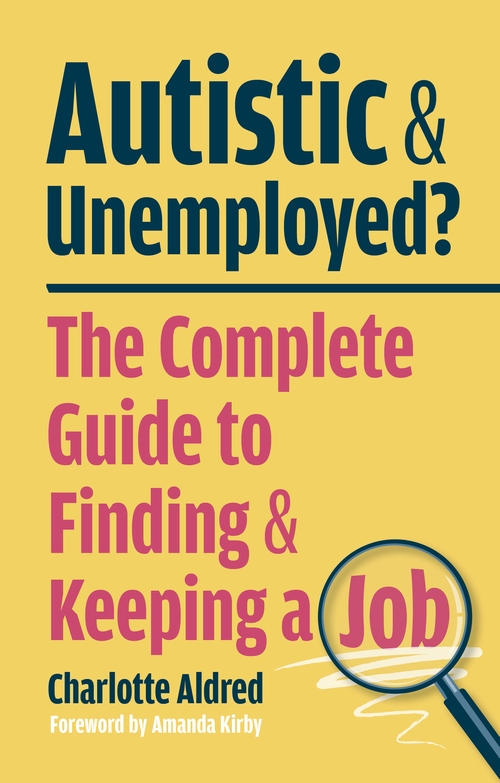
I wrote Autistic and Unemployed? to help autistic adults feel informed about the challenges job-hunting may present, and empowered to ask for extra support and accommodation as needed. In the book, I provide advice around job searching, applications and the world of work, tailored to some of the particular challenges I know autistic people face. I would love a world where autistic adults have equality in the workplace, and where their strengths and skills are able to shine.
Addressing the challenge of interviews
Interviews are one area that often come up as a point of concern for autistic applicants – the need to manage logistics and social interaction alongside nerves can feel like a perfect storm. But it’s fine to ask for accommodations to help you with this side of things. If you’re someone who is anxious about this aspect of your job-hunting journey, you might like to consider the following suggestions:
Examples of accommodations that might be helpful before an interview:
- the opportunity to request a specific interview time – for example to avoid rush-hour travel,
- the opportunity to ask for an alternative venue, date or time if you can’t get to the interview, perhaps because of transport issues,
- confirmation by email of any arrangements made over the phone,
- interview questions to be provided in writing a few days before the interview so that you have the extra processing time you need in order to enable you to prepare properly, perhaps by making yourself some notes /bullet points you can refer to in the interview,
- details of job tasks to be provided in writing a few days before the interview,
- information about the interview structure, including a clear timetable of events during the allocated interview time and detailing any exercises that will be included in the process,
- clear written and visual information to be provided about the interview including some of the following:
- directions to the interview location (ideally with a map and/or pictures of the front of the building),
- instructions on how to find the interview room (if you are not being met at reception),
- a photo of the room in which the interview is to be held,
- the dress code for the interview,
- the procedure on arrival,
- who will meet you,
- names and photos of people on the interview panel with details of their role in the company and what role each will play in the interview such as note taking or asking technical questions,
- a visit to the site of the interview in advance.
Examples of accommodations you might like to request for the interview itself:
- a work trial in addition to the interview or instead of it,
- the interview to be based on your portfolio,
- to be interviewed remotely instead of in-person,
- to submit a written or filmed response to predetermined interview questions which could then form the basis of a face-to-face interview,
- to face as few interviewers as possible,
- for you to wait, prior to your interview, in a quiet and calm space away from other people,
- for the interview itself to be conducted in a quiet, calm room which is not too hot or cold and doesn’t contain other things which may cause you sensory distress such as bright lights,
- for the interviewers to avoid social chit-chat at the beginning of the interview,
- for the interviewers to allow no interruptions during the interview,
- to be met at the entrance and guided to the waiting area or interview room if the location is new to you,
- for a supporter to come into the interview with you to ease communication between the interviewer and yourself, reword any unclear questions, prompt for more information and help you to understand exactly what the interviewer wants,
- to ask the interviewers not to assess you negatively if your eye contact or body language seem unusual (to a non-autistic person), because this helps you focus,
- for adequate breaks during long interviews and to let you to take a break if you feel you need it,
- to be allowed to furnish written responses during the interview or to refer to your written notes,
- not to be rushed and to be provided with extra time to process information and questions, or undergo any selection tests,
- for the interviewers to avoid any multi-part questions – this should make it easier for you to concentrate on answering one query at a time without the need to remember any other questions,
- for the interviewers to:
- be direct,
- say exactly what they mean,
- identify precisely what they want,
- use specific and closed questions based on your past experience instead of vague, hypothetical or abstract questions such as ‘tell me about yourself’ or ‘how do you think you’ll cope with working if there are lots of interruptions?’,
- avoid role play,
- avoid indirect patterns of speech such as clichés, implied meanings, and idioms,
- be clear about the kind and quantity of information wanted in an answer,
- prompt you in order to extract sufficient information,
- tell you if you are are talking too much or giving too much information,
- ask the same question in a different way if the answer is unexpected.
(Many more examples of workplace accommodations as well as training, coaching and self-help strategies can be found in the book).
It may feel daunting to ask for accommodations like this, but don’t forget that if you’ve been invited to interview then the company clearly recognise that you have skills and experience they are interested in. They are reasonable requests and any good employer should be open to looking at what’s possible. If the organization you are applying to is unwilling to cooperate, it would suggest that it may not be a supportive environment to work in, no matter how good it looks on paper. Remember, when it comes to interviews, you are interviewing a potential employer as much as they are interviewing you.
After a career as a research scientist, Charlotte Aldred retrained as a management accountant and later as a project manager. She has held several senior management positions within the private sector. Charlotte has written and published on autism, and parents an adult autistic son who has never been out of work. Charlotte’s book, Autistic and Unemployed, publishes on 21st October 2026 and is available to pre-order here.