Dr Karen Treisman on Trauma-Informed Practices in the Real-World
By Dr Karen Treisman, Author of Navigating the Journey to Trauma-Informed Organizational Change
Over the last several years, I have had the privilege of writing, training, consulting, and thinking alongside organisations at many different points in their trauma-informed journeys. My previous trauma-informed organisational books, A Treasure Box for Creating Trauma-Informed Organizations, explore many of the foundational concepts, values, principles, and practicalities of trauma-informed organisational change, drawing on learning, reflections, examples, and experiences from a wide range of organisations and settings. Alongside these, Trauma-Informed Health Care takes many of these ideas and applies and explores them specifically within the particular context and complexities of healthcare.
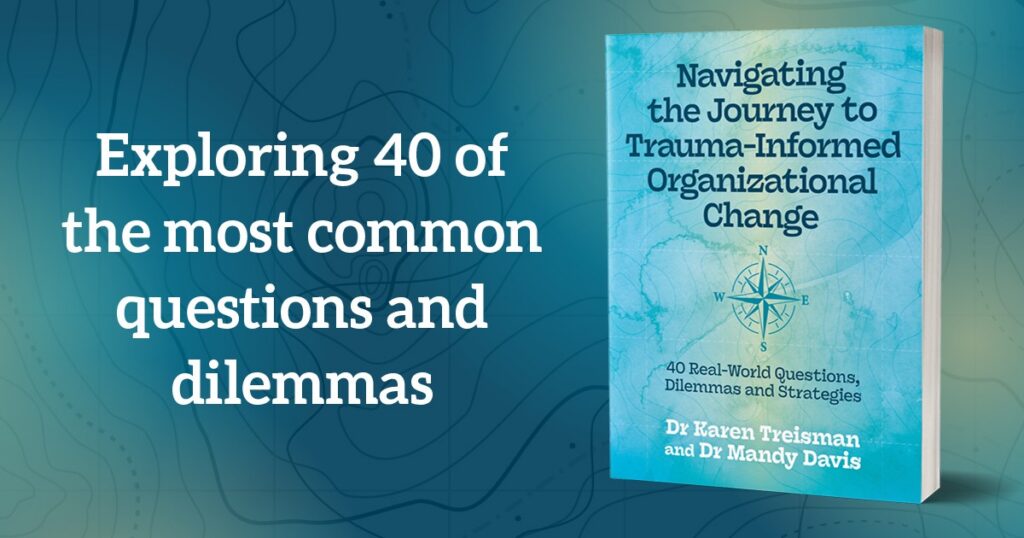
Our new book which we are very excited about, Navigating the Journey to Trauma-Informed Organisational Change: 40 Real-World Questions, Dilemmas and Strategies, sits very much alongside and complements these books, but takes the conversation into a different space. It wades further into the thorny, muddy, messy bits: what happens when we genuinely try to live, breathe, embed, and sustain these ideas within complicated, stretched, imperfect, real-world organisations?
That feels particularly important at this moment. Trauma-informed practice has gained enormous momentum and traction across health, social care, education, justice, charities, businesses, and many other sectors. That brings huge opportunities, but also some important questions. Has trauma-informed become a buzzword? Is it sometimes reduced to a checklist or training day? What happens when values and viability collide? Can we work in a trauma-informed way when resources are shrinking? Is understanding trauma the same as excusing harmful behaviour? What if I want to work this way but the wider organisation does not? And what does any of this have to do with somebody working in HR, finance, estates, administration, an airport, or a theatre? These are not abstract questions. They are the kinds of thorny questions Mandy and I hear repeatedly in consultation rooms, reflective spaces, training sessions, leadership conversations, and organisations.
This is why the structure of the book is deliberately different. It is organised around 40 real-world questions and dilemmas, with short, accessible chapters that can be dipped into rather than necessarily read from beginning to end. We wanted to create something that could sit on a desk, in a team meeting, within reflective supervision, at a leadership away day, or alongside an organisational change process. A single question might become a team conversation, a micro-learning opportunity, or simply a prompt to pause and wonder. We know how busy and overstretched many people and services are, so the book is intentionally designed to be something you can not only read, but use.
Writing it together has also allowed us to bring two different but complementary lenses, from both the UK and the US. We certainly do not pretend to have one neat answer to every dilemma. In fact, part of the purpose of the book is to resist doing exactly that. Trauma-informed organisational change requires us to stay curious, reflective, relational, and willing to sit in the grey. In that sense, we hope the book itself models the model rather than simply describing it.
Perhaps most importantly, this book comes from a place of both hope and healthy challenge. We remain committed to the possibilities of trauma-informed practice, while also believing that protecting its integrity means being willing to question it, stretch it, and have some of the conversations that can otherwise become elephants in the room. For us, this is part of the evolution of the trauma-informed movement: moving beyond awareness and good intentions towards complexity, accountability, sustainability, and what these values actually look and feel like in everyday organisational life. It is less about having all the answers and more about continuing to ask richer questions, together.
Written by award-winning psychologist Dr Karen Treisman and clinical social worker Dr Mandy Davis, Navigating the Journey to Trauma-Informed Organizational Change: 40 Real-World Questions, Dilemmas and Strategies explores the real-world complexities of trauma-informed practice and trauma-informed care through a question-led approach designed for practical, real-world use. Find out more here.