ADHD at Work: The Job Is Only Part of the Job
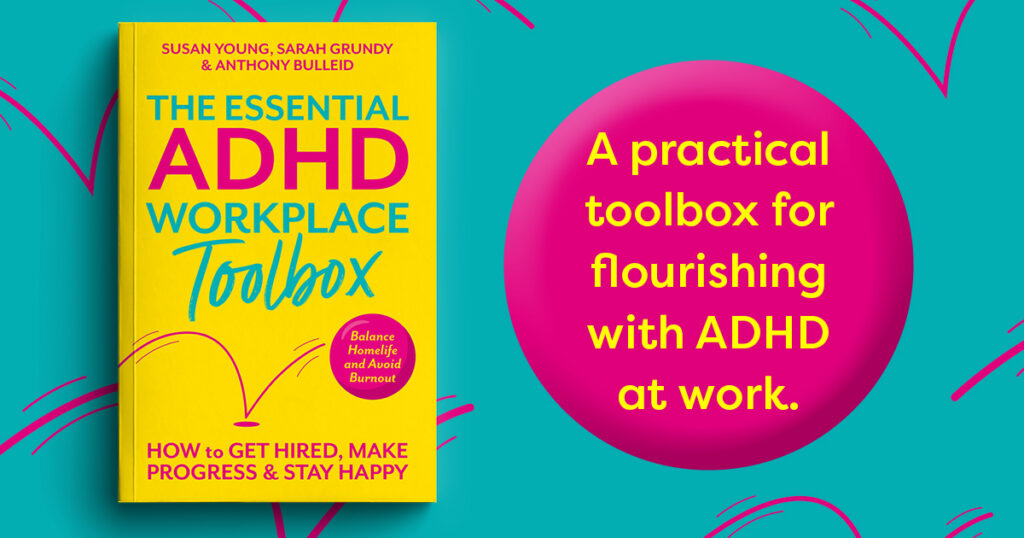
Written by Susan Young. Susan’s new book, co-authors with Sarah Grundy and Anthony Bulleid, The Essential ADHD Workplace Toolbox publishes on 21st October 2026 and is available to purchase here.
Much of the public conversation about adult ADHD focuses on recognition and diagnosis. Getting an explanation for difficulties you may have experienced for years can be enormously important.
But diagnosis is not the end of the story.
You still have to go to work on Monday morning.
And having ADHD at work is not simply about whether you can do the job. In fact, you may be extremely good at the central part of your job. The difficulties can lie in everything that surrounds it: deciding what to do first, remembering follow-ups, managing competing deadlines, working out the unwritten rules, responding to feedback, making your contribution visible and switching off at the end of the day.
Over time, these apparently small things can have a surprisingly large effect on confidence, performance and career progression.
So what can help?
1. Stop trying to keep everything in your head
Working memory is not a reliable filing cabinet. Yet many of us behave as though it is.
Someone asks you to send something later. You remember a task while you are in a meeting. Your manager gives you three follow-up actions. You tell yourself: “I’ll remember that.”
Then the day moves on.
For someone with ADHD, one of the simplest changes can be to externalise information. Capture actions as soon as they arise. Put appointments in the calendar. Write down the next step. Use reminders, checklists or a visible task list.
But beware of the opposite problem: tool overload.
A new productivity app can feel like the answer to everything – for about a week. Then another one looks even better. Before long, your organisation system has become another thing you have to organise.
Try this instead:
- Choose one calendar and one main task list.
- Capture actions immediately rather than relying on memory.
- Break an unclear or difficult task into one very small first step.
- Stick with a system for long enough to find out whether it actually helps.
The aim is not to create the perfect system. It is to create one you will actually use.
2. Don’t guess the unwritten rules
Every workplace has rules that appear nowhere in the employee handbook.
How much should you speak in meetings? How quickly are emails expected to be answered? Is it acceptable to challenge a manager openly? How much personal information do colleagues share? What does “take ownership” actually mean in this organisation?
For someone with ADHD, particularly when impulsivity, rapid communication or difficulties picking up subtle cues are involved, these unwritten expectations can create problems even when the quality of your work is good.
The answer is not to spend your working life anxiously trying to read other people’s minds.
Ask.
If an instruction is vague, seek clarification. If feedback is unclear, ask what specifically needs to change. If you are unsure how something is normally handled, a trusted colleague or mentor can save you months of trying to work it out alone.
And if something goes wrong (perhaps you interrupt, respond too quickly or misjudge an interaction) do not disappear afterwards. A brief acknowledgement or apology followed by normal engagement is often much more effective than withdrawing and replaying the encounter for days.
3. Don’t assume good work will speak for itself
This is what we call the quiet high-performer trap.
You work hard. You deliver something excellent. Then you move straight on to the next problem and assume somebody will notice.
They may not.
Career progression is partly about doing good work, but it is also about making your contribution visible in an appropriate way. This can feel uncomfortable, particularly if you associate talking about your achievements with boasting.
It doesn’t need to be.
Keep a simple record – a “glory file” – of things you have delivered, problems you have solved, positive feedback and measurable outcomes. Before an appraisal or promotion discussion, you then have evidence rather than having to remember everything on the spot.
Also ask what matters most to your organisation. ADHD can bring enormous energy and enthusiasm, but working extremely hard on something that nobody regards as a priority is unlikely to help your career.
Remember: reliability builds reputation. Closing the loop on the small things (replies, actions and deadlines) matters alongside the big achievements.
4. Use your strengths — but give them structure
ADHD is often discussed only in terms of difficulty. That misses an important part of the picture.
Many people with ADHD bring creativity, energy, curiosity, rapid thinking, adaptability and an ability to see possibilities other people miss. Some thrive under pressure or become deeply absorbed in work that interests them.
Those qualities can be valuable. But strengths work best when they are supported by structure.
Hyperfocus, for example, can produce extraordinary concentration – but hyperfocus overrun can mean spending so long on one task that emails, admin or other deadlines disappear from view.
Novelty can generate enthusiasm and ideas – but constantly jumping to the next exciting project before finishing the current one can damage trust.
Creativity and entrepreneurship can flourish with freedom – but freedom does not mean the absence of routines, boundaries or systems.
The question is not simply, “What am I good at?”
Ask instead:
- What kind of work brings out my strengths?
- Under what conditions do I work at my best?
- What tends to derail me?
- What structure do I need around me so that my strengths are sustainable?
The right environment cannot remove every ADHD difficulty, but the fit between the person, the role and the workplace matters enormously.
5. Don’t wait for burnout before you protect your life
People with ADHD can become very good at running on urgency.
A deadline creates adrenaline. Adrenaline creates focus. The work gets done.
So you do it again.
The problem is that a working life powered by permanent emergency is difficult to sustain.
There is also the ‘always-on trap’: checking one email in the evening, replying to one message, finishing one small task – and suddenly work has followed you home.
Try creating a deliberate end to the working day. Decide your working hours where you can, have a simple shutdown routine, and make boundaries visible to other people.
Be careful, too, about saying yes too quickly. The immediate enthusiasm of taking something on can arrive long before the reality of fitting it into an already crowded week.
Protecting your energy is not separate from performing well at work. It is part of performing well over the long term.
The bigger picture
Living and working with ADHD is not about forcing yourself to work exactly like everybody else.
It is about understanding where your particular pressure points are, putting practical supports around the things that are harder, and creating more opportunity for your strengths to come through.
And that changes over a career. The strategies you need when applying for your first job may be very different from those you need when managing a team, pursuing promotion, changing direction, starting a business or trying to create a healthier balance between work and the rest of your life.
That is why Sarah Grundy, Anthony Bulleid and I wrote The Essential ADHD Workplace Toolbox: How to Get Hired, Make Progress, and Stay Happy. It is written directly for people with ADHD, rather than as a clinical guide for healthcare professionals, and follows the whole working journey – from finding work and settling into a role to building a career that is successful, sustainable and works for you.
Because getting the job is only the beginning.
Susan Young, DClinPsy, PhD, is a consultant clinical psychologist and director of Psychology Services Ltd. An Honorary Professor at Reykjavik University, she has over 30 years’ experience in the field of ADHD, has led international ADHD guideline work, and developed widely used assessment and treatment programmes, including the ACEv.2 and ACE+v.2 interviews, now available in over 25 languages, and published extensively in clinical and academic settings.
Susan’s new book, The Essential ADHD Workplace Toolbox, publishing on 21st October 2026, is available here.