What Does Sex Worker-Affirming Care Really Look Like?
Written by Alessandra Lanti, author of Supporting Sex Workers, out now.
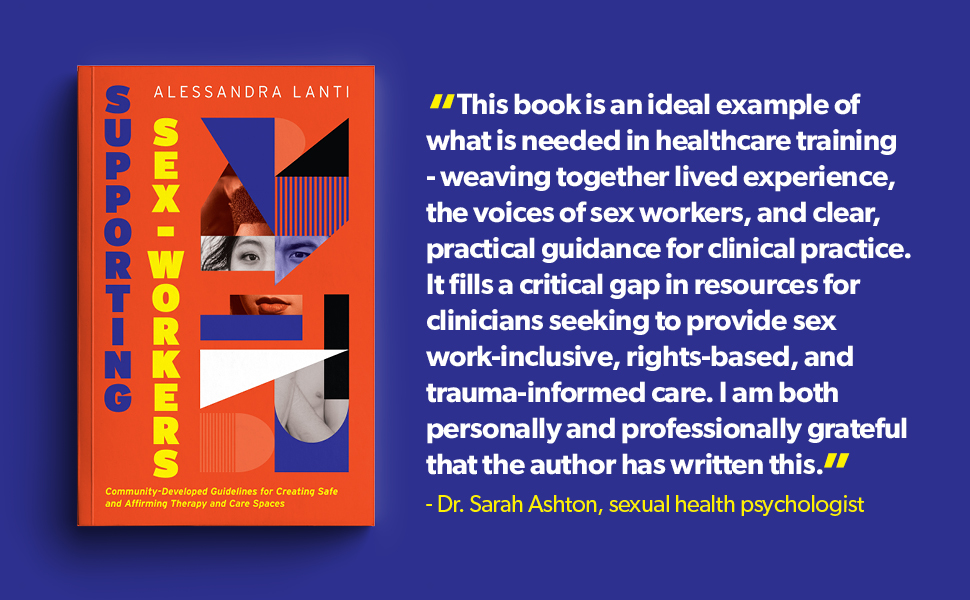
Supporting Sex Workers: Community-Developed Guidelines for Creating Safe and Affirming Therapy and Care Spaces is the first book of its kind, written by a former sex worker, centering the voices and lived experiences of sex workers through their own words and exploring therapy from the perspective of sex workers as consumers of mental health services.
Although I had often thought about writing about my experiences working in the sex industry, I never imagined I would write a book about sex work and mental health. That changed when I moved to Las Vegas, Nevada, the City of Sin.
In 2016, I began facilitating a support group for sex workers. I wanted to use my background in psychology to address what I saw as a significant need in the community: nonjudgmental, affirming services for people working in the sex industry. At the time, Las Vegas offered few culturally competent services for sex workers.
I found this ironic. Las Vegas is marketed around the world as Sin City, a tourist destination for gambling, nightlife, and adult entertainment. Living, working, and studying there, I quickly realized that the city capitalizes on its “sex and sin” allure, as do the countless people employed in the margins of the sex industry and those whose livelihoods depend on it. Yet this does not necessarily translate into support for sex workers themselves, who are often left without adequate services to turn to.
It was no wonder I felt a support group was needed.
Initially, reaching the local sex worker community was difficult. Nevertheless, I continued hosting groups, even when attendance was low, thanks to the help and generosity of a few people who shared my commitment to supporting marginalized and underserved communities. Over time, our group became one of the few—and at times, the only—safe spaces for sex workers in Las Vegas.
We offered our services free of charge and welcomed sex workers from all sectors of the industry, across sex and gender identities, and with diverse backgrounds and experiences.
Providing support to sex workers in Las Vegas gradually grew into a desire to write a book about their therapeutic needs and the best practices for meeting them. This desire was strengthened by hearing the many stories of sex workers who had felt misunderstood or invalidated by support agencies and who had been harmed by law enforcement, organizations claiming to rescue them, and well-meaning therapists who knew little about the sex industry and brought their own biases and prejudices into the clinical room.
The invaluable knowledge I gained from facilitating the support group became part of the foundation of this book. However, the book was also inspired by my own dismay and by the painful awareness that, when I was working in the industry, I had no one to turn to when I needed support. I felt I could speak only to other sex workers; they were the people I felt safe with and believed understood me.
I want this writing to help change that reality for others.
My intention is to offer therapists and support organizations a practical, thoughtful manual for providing care that is respectful, inclusive, and affirming. The guidance is developed in partnership with sex workers, whose voices are too often ignored, and grounded in cultural sensitivity, intersectionality, and real-world experience. Written for therapists, support workers, coaches, healthcare professionals, academics, and students in these fields, the book approaches care from the perspective of sex workers themselves. It may also be useful to sex workers, whether to recommend it to their providers or to help them identify professionals who offer sex work-affirming care.
Sex work is often misunderstood, reduced to stereotypes, or discussed primarily through the lens of morality, exploitation, or controversy. These narrow representations have profound consequences, not only for sex workers themselves but also for the professionals providing mental health, medical, social, and other support services.
The book draws on my lived experience, many years of working with sex workers as a counselor, research on sex workers’ mental health and safety, participation in international projects, and conversations with sex workers about their experiences with healthcare and mental health professionals. It is also informed by conversations with clinicians and other professionals who want to provide better care but may not always know where to begin.
Sex workers are not a homogeneous group. They have different backgrounds, identities, needs, relationships, motivations, working conditions, and experiences. Their lives cannot be understood through simplistic assumptions about who they are or why they do the work they do. Good care begins with making room for that complexity.
In the book, I encourage readers to adopt a more nuanced understanding of sex workers’ lives, explore how stigma operates in healthcare and mental health settings, and consider how even well-intentioned professionals can unintentionally reproduce harmful assumptions.
But this is not simply a book about what professionals should not do. It is fundamentally a practical guide to what they can do.
Readers will find concrete ways to make their practices more welcoming and affirming, from the language used in forms and websites to the assumptions embedded in policies, clinical conversations, assessments, and treatment. The book considers how professionals can create environments where clients do not feel they must hide their work, justify their lives, or educate their providers before receiving appropriate care.
One of the most important principles underlying my writing is that sex workers themselves must have a meaningful voice in determining what respectful care looks like. This is not a guide written solely from the perspective of professionals studying sex work from the outside. Sex workers’ experiences, knowledge, and perspectives are central to its approach. Their voices help identify where systems fail, what makes a difference, and what genuinely affirming care looks like in practice.
Supporting Sex Workers is an invitation to look more closely at how we practice, what we assume, and the messages we communicate, sometimes without realizing it. It offers an opportunity to replace stereotypes with curiosity, judgment with respect, and uncertainty with practical knowledge.
Most importantly, it is a call to recognize that sex workers, like most clients, care less about which schools their therapists attended or which techniques they will use to “treat” them than about an authentic connection and a willingness to sit with them with humility and in a spirit of equality and collaboration. Sex workers deserve to be treated with profound respect and humanity, not as projects. In this space, healing and deep understanding can take place.
When professionals create spaces where people do not have to hide important parts of themselves to feel safe, care becomes more honest, more collaborative, and ultimately more effective.
Alessandra Lanti holds a Master of Arts degree in Clinical Psychology and a Ph.D. in Sociology from The University of Nevada, Las Vegas (UNLV). She has both lived experience and clinical experience in sex work and serving the sex worker population. Her book, Supporting Sex Workers, is out now.