Written by Daniel O’Shaughnessy. You can order Daniel’s books, Letting Go of Perfect, and pre-order Daniel’s latest book, The Queer Guide to Nutrition and Lifestyle, here.
I’ve been a nutritionist for about 15 years now, and one thing I have learned is that mainstream wellness loves a simple formula, often rooted in control: eat clean, exercise more, sleep for eight hours and practise self-care. Follow the rules consistently enough, and a supposedly healthier, happier version of you will emerge.
For years, I believed mainstream health advice was the answer. I followed the rules, pushed myself harder and treated changing my body as proof that I was doing well. It was only when I began my own healing that I recognised how much of my life had been shaped by adaptation. The pursuit of a more acceptable body was not simply about health. It was bound up with shame, minority stress and rejection. I was not only trying to become healthier (which had no end goal); I was trying to become someone I believed the world would accept.
My experience is not unusual. Many queer people learn to adapt before they understand what they are adapting to. Yet mainstream advice rarely accounts for how trauma, rejection and minority stress can shape our relationship with our bodies and our behaviour. Without consciously recognising what is driving us, we can end up cycling through different diets, biohacks and supplements every week, hoping to gain an edge in productivity, add a few more pounds of muscle or finally feel that we are enough.
The imaginary “default” patient
Much health advice is still written for an assumed heterosexual, cisgender reader. When queer health is discussed, it is often reduced to one of two extremes: crisis prevention or aesthetics. We see the alarming public-health statistic or the muscular cover model. What is missing is the messy middle: the everyday reality of queer people who want more energy, better digestion, a calmer relationship with food or simply to feel more at home in their bodies.
In reality, we often find ourselves navigating systems that misgender us, misunderstand our relationships or lack basic knowledge about gender-affirming hormones, HIV and PrEP. I have lost count of the clients who have told me they felt unable to discuss how IBS was affecting their sex life because they feared being judged. Others have told me that when they disclosed they were taking PrEP, a healthcare professional mistook it for an HIV diagnosis. Experiences like these make it harder to ask questions openly and receive appropriate care.
Our identities, relationships and lived experiences shape how we access care and respond to health advice. Recognising that context is essential to providing care that is relevant, safe and effective.
Wellness turns structural problems into personal failures
Mainstream wellness often treats health as an entirely individual responsibility. It leaves little room for the conditions that shape our wellbeing, including discrimination, financial insecurity, unequal access to healthcare and the ongoing effects of minority stress. When these factors are ignored, people are encouraged to interpret their struggles as personal shortcomings.
This can intensify the wounds many queer people already carry. Many of us have learnt to monitor how we speak, move, dress or take up space. We may have grown up believing that safety, acceptance or love depended on presenting the right version of ourselves. Introducing another set of expectations can turn looking after ourselves into another performance we are afraid of getting wrong.
Food and exercise can become ways of managing anxiety, dysphoria or a persistent sense of inadequacy. Pursuing an “ideal” body may provide temporary relief, but it rarely reaches the pain underneath. For many queer people, appearance is tied to something much deeper than vanity. It can feel connected to safety, desirability, acceptance and belonging.
More discipline cannot heal a wound created by shame. Until wellness recognises what we are trying to survive, it will keep prescribing control when what we need is care.
Queer health advice has to be honest about how we live
For many queer people, nightlife offers freedom, community and a place to express desire without apology. Alcohol and substances may be part of that experience without necessarily indicating that something is wrong. For others, substance use can become entangled with trauma, loneliness, chemsex, intimacy, dysphoria or the desire to feel confident and connected. Both realities can exist at once.
Mainstream wellness tends either to ignore these experiences or condemn them. Neither response gives people the information they need. Honest health advice should acknowledge pleasure as well as risk, while offering practical ways to reduce harm, recover and recognise when more support may be needed. Judgement does not prevent risky behaviour. It simply makes people less likely to talk about it.
Queer health needs more than a rainbow logo
Inclusive wellness requires more than adding LGBTQ+ language to generic health advice. It requires an understanding of how queer people’s bodies, relationships and experiences can affect their health needs.
Gender-affirming hormone therapy, for example, is not interchangeable with hormone treatment for cisgender people. Fertility advice should not assume someone’s gender, anatomy or family structure. Guidance on sleep, digestion and mental health should also recognise the effects of minority stress rather than treating each symptom in isolation.
This does not mean creating another set of rules for queer people to follow. Good health advice should be flexible enough to account for pleasure, culture, relationships, financial circumstances and what someone can realistically manage. It should help people make informed decisions without expecting them to pursue health perfectly.
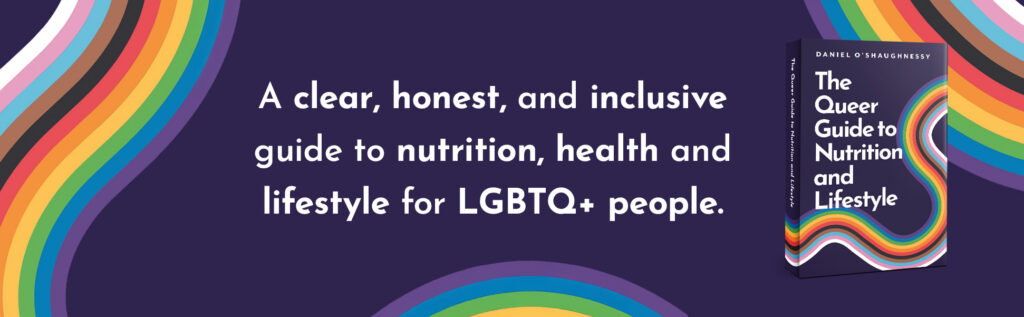
I wrote The Queer Guide to Nutrition and Lifestyle because I could not find a single resource that took this approach. The book combines practical nutrition guidance with subjects that mainstream health books frequently overlook, including gender-affirming care, HIV, sexual health, body image, mental health, fertility and the party lifestyle. It draws on scientific evidence, professional practice and lived experience to provide advice that reflects the questions queer people are actually asking.
Queer health is not a specialist concern that can be added as an afterthought. It is part of everyday healthcare, and it should be treated that way.
Daniel O’Shaughnessy is a nutritionist, functional medicine practitioner and therapist specialising in LGBTQ+ health. With 15 years of experience, his work explores the connections between nutrition, minority stress, body image, mental health and identity. He is the author of Letting Go of Perfect: A Gay Man’s Guide to Healing from Body Dysmorphia. His new book, The Queer Guide to Nutrition and Lifestyle, is published by Jessica Kingsley Publishers on 21 September 2026.