The 12 Days of Christmas Calm
Written by Emma Connor. You can order a copy of Emma’s book, The Anxious Classroom, here.
You’ve said goodbye to a very hot summer and, as a tingle of cool touches the air and the leaves begin to crisp, it’s time to welcome your new class and begin what many children and school staff say is the most stressful, anxiety inducing time of the year: the autumn term.
And yes, I’m sorry, I am going to name it… the build up to Christmas!
There are going to be plenty of jingle bells and snowballs this term that wobble your Christmas spirit or provide as much overwhelm as a Christmas elf full of candy canes with a million presents to wrap.
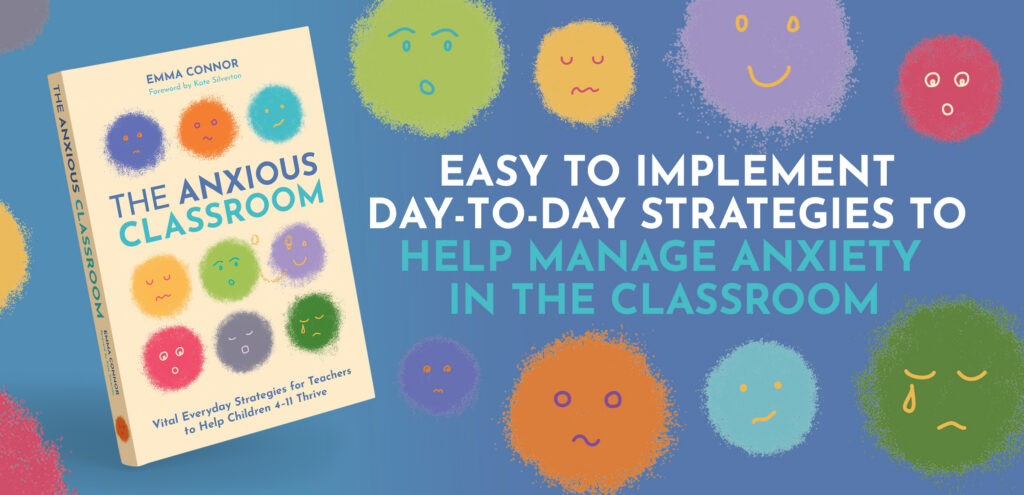
With this in mind, I offer you The 12 Days of Christmas Calm: a little stocking filler to complement all the strategies you will find in my recently published book, ‘The Anxious Classroom.’
Why is the autumn term stressful?
You need to get to know a whole new class of children, assess them, soothe them and help them grow. Many children will come to you with a sense of relief because school is their safe place. Others may return full of anxiety because school is not a peaceful place for them, but somewhere they mask.
Some children will express their emotions in ways you may find hurtful, shocking or deeply worrying. Your learners also have parents and carers who bring their own anxieties. I haven’t even started on the general pressures of being a teacher: meeting those targets, getting the admin done and keeping everything moving along.
I imagine the reason you are an educator is because you have a heart that is open to all children and a drive to do the best for them. But let’s be real: this is not always easy. You are not Father Christmas, with an endless sack of energy, strategies, time and cheer!
So here is my early Christmas gift to you:
The 12 Days of Christmas Calm
Feel free to sing it if this provides you with regulation!
On the first day of Christmas, The Anxious Classroom gave to me… A Warm Consistent Welcome
Warm, therapeutic relationships where a child feels truly seen are one of the most significant experiences we can offer them in developing self-esteem and an enthusiasm for learning.
Greet every child like they are a lovely Christmas pudding. And, just as you would light a Christmas pudding, don’t forget to greet them with a warm smile and genuine enthusiasm.
Use your face, voice and body language to light them up, so they can have a delicious day of learning!
On the second day of Christmas, The Anxious Classroom gave to me… A Regulation Countdown Calendar
Regulation breaks can easily drop to the bottom of your to-do list, but those little “keep steady” breaks are essential. They can help children calm and become ready to learn, particularly our children who are neurodivergent.
A calendar can provide routine, predictability and structure. So why not create a Christmas Countdown Calendar with a different regulation activity each day?
For December school days, put a new activity on a Post-It note. It could be a lap of the playground, tapping, mindful doodling or one of the strategies from Chapter 3 of ‘The Anxious Classroom.’
You are building regulation skills while giving children something festive to look forward to.
On the third day of Christmas, The Anxious Classroom gave to me… An Inclusive Christmas Concert
Christmas concerts and nativities can bring huge amounts of joy, but they can also bring huge amounts of stress.
Not every child wants to shine on stage. For some, standing in front of an audience can feel exposing and overwhelming. Think creatively about the roles you offer.
I once worked with a child who was extremely anxious about the nativity. His teacher and parents thought he might manage simply standing on stage, but he felt exposed and under pressure. Together, we negotiated a different role. He could be the door opener and closer, wear his regular school uniform and greet people as they arrived. He absolutely thrived.
He even received a special thank you from the headteacher, and the experience had a lovely impact on his self-esteem.
Sometimes inclusion means changing what we think participation needs to look like.
On the fourth day of Christmas, The Anxious Classroom gave to me… Empathic Boundaries
Children need boundaries, but how we deliver them can make all the difference.
Empathy can change how a child experiences a boundary and help us maintain the therapeutic relationship, even when we need to say no.
Connect before you correct!
Try:
“I can hear this is really hard for you. I want to help you follow this school rule for your safety.”
The boundary remains. But the child also hears that you are with them, not against them.
On the fifth day of Christmas, The Anxious Classroom gave to me… Five Cups of Tea
Five cups of tea may not be enough to get you through the term, but it’s a good start!
You are someone’s teacher, but you are also a person who deserves to feel valued, supported and important.
Take care of yourself and your colleagues. Put your out of office on. Start a before school staff ten-minute meditation group. Eat something nutritious at lunchtime. And, perhaps most importantly, actually take your break!
Your mental health matters too.
On the sixth day of Christmas, The Anxious Classroom gave to me… Six Expectations, Not Sixty!
The autumn term can bring a temptation to introduce every rule, routine and expectation all at once.
But less can be more. Focus on the expectations that are genuinely essential for safety, learning and relationships.
Anxious children and those who are neurodivergent can become overwhelmed by long instructions and endless expectations. Instead of asking, “Why isn’t this child following the expectation?” try asking:
“Have I made this expectation clear, achievable and accessible?”
On the seventh day of Christmas, The Anxious Classroom gave to me… Get to Know Them Missions
There is something incredibly powerful about being held in someone else’s mind.
Think of every little piece of knowledge about a child as a shiny, sparkly bauble you are adding to your classroom Christmas tree.
Find out something that is truly unique to them:
Their favourite game.
Something they could talk about for hours.
Their pet.
A strange fact they know.
Something they are proud of.
Then hold onto it.
This knowledge becomes something you can reach for to start a conversation, connect, celebrate or repair.
It sends a powerful message:
“My teacher remembers that about me.”
“I am noticed.”
“I matter.”
“I am held in someone else’s mind.”
That sense of being known and remembered can become a little pocket of psychological safety.
On the eighth day of Christmas, The Anxious Classroom gave to me… Ways to Say “Yes”
Some children may hear the word “no” a lot at home and at school.
“No, you can’t do that.”
“No, not now.”
“No, that’s not how we do it.”
“No, you need to wait.”
Boundaries are important, but whenever possible, look for ways to offer a yes within the boundary.
“Yes, you can draw! Let’s find a space where your masterpiece can happen without getting covered in paint.”
“Yes, I’d love to hear all about it. Give me a few minutes to finish helping your friend, then I’m all yours.”
“Yes! You can choose which one you’d like to start with. Which one is calling your name?”
“Yes! Your body is telling you it needs to move. Let’s get those wiggles out, then we’ll come back together.”
A therapeutic classroom can have clear boundaries without children experiencing those boundaries as rejection.
On the ninth day of Christmas, The Anxious Classroom gave to me… Opportunities to Repair
Even the warmest therapeutic classrooms will have difficult moments.
We lose our patience. Children become overwhelmed. Sometimes words come out that we wish we could take back. Relationships wobble.
But these moments can become opportunities to teach children something incredibly important: relationships can be repaired.
After a difficult moment, find a way to reconnect.
“I didn’t handle that very well earlier. I’m sorry.”
“I think we both became a bit overwhelmed.”
“I was cross, but I still care about you.”
“Shall we have another go?”
Repair does not mean removing the boundary or pretending the difficult moment did not happen.
It means showing children that conflict does not have to mean rejection.
On the tenth day of Christmas, The Anxious Classroom gave to me… Sparkles of Connection
Children’s brains are built through relationship, movement, curiosity, laughter and play.
Play and shared joy are medicine for emotional overwhelm and healthy brain development.
Moments of shared joy can help children feel safe, connected and regulated, and they don’t need to take ten minutes or require a special activity.
Share a joke.
Have a quick game.
Set a playful challenge.
Dance for thirty seconds.
Smile.
These tiny moments matter.
They remind a child’s nervous system “I am safe, I belong, I am important to you.”
On the eleventh day of Christmas, The Anxious Classroom gave to me… Expectations of Christmas Chaos
By the time you get to the end of term, you may need to throw your usual expectations out of the window just a little.
The run up to Christmas can be incredibly dysregulating: Parties. Performances. Christmas jumpers. Altered timetables. Visitors. Trips. Films. Rehearsals. Music. Sugar!
Before deciding that behaviour has suddenly “gone downhill”, ask yourself:
“What has changed?”
A different environment, timetable or level of sensory input can lead to a very different presentation of behaviour but lowering expectations does not mean lowering standards. It means offering more support when predictability has disappeared in a puff of Christmas glitter.
Try saying:
“Today is different. There are lots of things happening, so we might need a little more help staying steady.”
On the twelfth day of Christmas, The Anxious Classroom gave to me… Things You Don’t Need to Fix
Perhaps the biggest gift you can give yourself this Christmas is permission to be ‘good enough.’
You do not need to fix every feeling.
You do not need to prevent every friendship difficulty.
You do not need to make every child happy.
You do not need the perfect strategy.
And you certainly do not need to get everything right.
Your role is not to create a classroom where children never struggle. It is to create a classroom where children do not have to struggle alone.
If, by the end of term, your children can look back and know that they were welcomed, listened to, given boundaries, helped to regulate, given opportunities to repair, laughed with, and cared for, then you have done something pretty magical.
And if you drank more than five cups of tea and somehow made it through the term too, I think you deserve a Christmas miracle.
Emma Connor is a child psychotherapist and director of Your Space Therapies, where she leads creative arts, play and talking therapy services, as well as training and consultancy for schools across the UK. A regular keynote speaker at education conferences, she is also an award-winning contributor to the Professional Education Systems Institute and a senior lecturer at the Institute for Arts and Therapy in Education.
Her book, The Anxious Classroom, publishes on 21st September 2026. Get your copy here.