We keep teaching children to speak up. But are we actually listening?
Chelsea Luker is an Autistic/ADHDer psychologist, author, and parent of two Neurodivergent children. Through her work, she empowers Autistic and ADHD people, parents, educators, and therapists to foster understanding, self-worth, and connection within Neurodivergent communities.
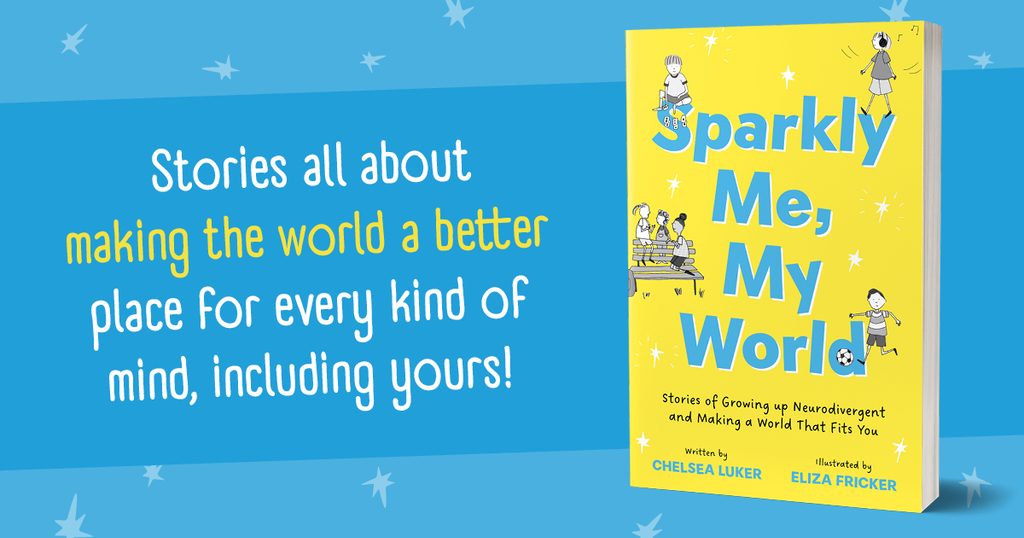
Her new book, Sparkly Me, My World has seven amazing stories celebrating children like you, who might think, feel, and see the world a little differently. These short stories are especially created for the neurodivergent child who needs to know the world can change to fit them, not the other way round.
“Use your words.”
“Tell someone what you need.”
“Stand up for yourself.”
We say these things to children all the time. And we usually mean well.
We want children to grow into adults who understand themselves. Who can recognise their needs, communicate their boundaries, ask for support, and advocate for the things that matter to them.
But I think we’re focusing on the wrong thing.
What happens when children do speak up, and the adults around them don’t listen?
What happens when a child tells us the classroom is too loud, but we tell them to get used to it? Or tell them, “its not that bad”.
When they say they’re overwhelmed, but we remind them that everyone else is coping just fine?
Or when they finally find the courage to say, “I can’t do this,” and we respond with, “Yes, you can. You just need to try harder.”
Ouch.
Because here’s the thing.
Teaching children to advocate for themselves means very little if we haven’t created a world where their advocacy actually leads to something.
And perhaps even more importantly, children shouldn’t have to advocate for every single thing they need.
Before children can advocate, they need to understand themselves.
As an Autistic ADHD psychologist and parent of Neurodivergent kiddos, I’m passionate about helping children understand their own brains, bodies, needs, and experiences.
Not through a lens of what’s wrong with them.
But through curiosity, compassion, and a genuine celebration of who they are.
Because how can a child advocate for something they haven’t yet learned to recognise?
A child might know that school feels awful but not understand that the noise, lights, and constant demands are overwhelming their nervous system.
They might know they’re exhausted after spending time with friends but not recognise how much energy they’ve spent navigating social expectations.
Sometimes, they might not even realise that things could be different.
That they’re allowed to need something different.
Self-advocacy begins with self-understanding.
But children don’t develop that understanding in isolation. They develop it through relationships with adults who help them make sense of their experiences.
Adults who notice.
Who get curious.
Who help them connect what they’re feeling with what they might need.
And who show them that needing support is part of being human.
Children shouldn’t have to manage everything alone.
In my book, Sparkly Me, My World, we meet Dino, who experiences some pretty big feelings.
And rather than expecting Dino to figure out how to manage those feelings independently, his parents support him through them.
They co-regulate.
They help him feel safe, supported, and understood.
And through those experiences, Dino learns something incredibly powerful.
My feelings aren’t too much. I don’t have to manage them alone. And the people who love me will help me when things feel hard.
This is something I desperately want all children to learn.
Because emotional regulation isn’t a skill we develop by being repeatedly left alone with feelings that overwhelm us.
It’s something we develop through connection, support, and repeated experiences of safety.
In Sparkly Me, My World, the adults don’t wait for the children to ask for accommodations.
They pay attention.
They notice when an environment isn’t working.
They anticipate needs and make adjustments.
They understand that supporting children isn’t simply about teaching them to cope with the world as it is.
Sometimes it’s about changing the world around them.
We have to make it safe for children to tell us what they need.
Imagine finally working up the courage to tell someone something really important.
Something vulnerable.
Something that might make you seem different, difficult, or inconvenient.
And being met with frustration, dismissal, or disbelief.
Would you try again?
Maybe.
But what if it kept happening?
Eventually, you might decide it was easier to stay quiet. To push through. To pretend everything was fine.
For many Neurodivergent folk, this becomes a familiar pattern.
We learn to ignore our discomfort, override our needs, and squeeze ourselves into environments that were never designed with us in mind.
We become incredibly skilled at looking okay.
Even when we’re really, really not.
One of my central philosophies when supporting children is beautifully simple:
I’m here. I’m listening. I believe you. And I will do whatever I can to help.
Not every problem will have an immediate solution.
Not every request will be possible to meet exactly as it’s made.
And we certainly won’t always get things right.
But we can remain curious.
We can be humble enough to recognise that our interpretation of a child’s experience might be wrong.
We can apologise, repair, and try something different.
And we can show children, through our actions, that their experiences matter.
Because safety isn’t created by telling children they can come to us with anything.
It’s created through what happens when they do.
Why are we asking children to do all the changing?
We spend an enormous amount of time teaching Neurodivergent kiddos skills to help them navigate the world.
How to manage sensory overwhelm.
How to regulate their emotions.
How to communicate their needs.
How to cope with change.
And yes, developing skills is important.
But what if we spent just as much time helping adults create environments where children didn’t have to work quite so hard to exist?
What if movement was a normal part of learning?
What if children could use headphones without needing to prove their distress?
What if quiet spaces, flexible seating, visual instructions, and different ways of participating were simply available?
What if we stopped treating inclusion like a special treat?
Because when we make environments more accessible for Neurodivergent folk, we often make them better for everyone.
The ADHDer might benefit from movement breaks.
So might the child who slept terribly last night.
The Autistic child might appreciate clear instructions and predictable routines.
So might the child feeling anxious about something happening at home.
And honestly, how many adults would love somewhere peaceful to sit when the world gets a bit too loud? Yes please!
Accessibility doesn’t always mean creating something different for every child.
Sometimes it simply means creating a world with more options.
More flexibility.
More curiosity.
More room for people to be human.
That’s where the sparkle happens.
When I think about the world I want for our children, I don’t imagine one where every child is confident, outspoken, and completely comfortable being different all the time.
That sounds like an awful lot of pressure, doesn’t it?
I imagine a world where children don’t have to fight so hard to be understood.
Where they can discover the things that make them delightfully themselves.
Where their differences are met with curiosity rather than correction.
And where adults recognise that supporting children sometimes requires us to question our own assumptions.
This is the heart behind Sparkly Me, My World.
It’s a celebration of individuality, but it’s also an invitation for adults to think differently about the environments and relationships we create.
Because a child’s sparkle shouldn’t depend on how successfully they can hide the parts of themselves that other people find inconvenient.
It shouldn’t depend on how well they tolerate discomfort.
Or how closely they can resemble everyone else.
Our children shouldn’t have to become smaller to fit into the world. It’s on us to make the world bigger.
So the next time a child tells you something is hard, uncomfortable, overwhelming, or simply not working for them, pause.
Get curious.
And ask yourself what you could change to make this easier?
Better yet, don’t always wait for them to ask.
Notice. Listen. Offer. Adapt.
Because perhaps the most powerful thing we can teach children about self-advocacy isn’t just how to use their voice.
It’s what it feels like when their voice is heard.
And when children learn that their needs matter, their differences are welcome, and they don’t have to navigate the world alone?
That’s when we give them the freedom to truly sparkle.