Racing the Kettle: Voice Practice for People Who Hate Routines
Written by Renée Yoxon, author of The Trans Voice Practice Journal, available to order here.
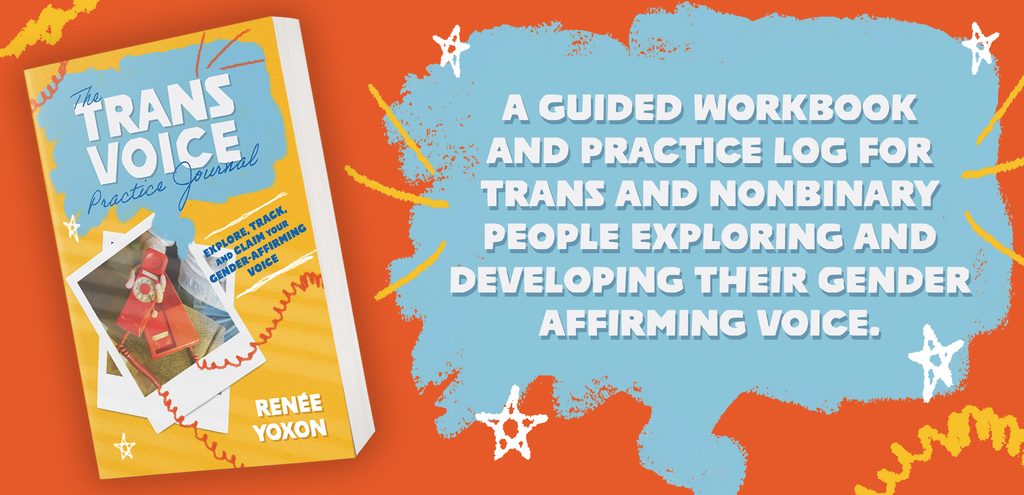
I’ve been teaching voice since 2008, specializing in gender-affirming voice since 2019, and I’ve never met two students whose practice looks the same. Some keep colour-coded spreadsheets, some scribble on napkins and receipts, some sit down for twenty focused minutes, and some sneak in thirty seconds while their coffee brews.
What almost all of them have in common is that, at some point, their practice falls apart, and they decide the problem is them. I’d like to offer a different explanation: if something doesn’t work for you, the problem is the process, not you. There is no ideal voice practice. The practice that you actually do is always objectively better than the one that causes you to abandon it.
In my new book, The Trans Voice Practice Journal, I suggest a different kind of goal for my gender-affirming voice students. “I want to pass” and “I want to have the voice I want” are fine and normal goals, but what does “having the voice you want” even mean when you’re tired, and your voice feels and sounds different from how it did yesterday? So instead, I offer this goal: becoming a person who practices. You can tell if you practiced today or not. And when you become a person who practices, the voice stuff tends to follow.
Habits run on what Charles Duhigg calls the habit loop: a cue, then an action, followed by a reward. Each strategy below works on the cue (making it easier to remember to practice) or the reward (making practice feel satisfying). As always, take what works and leave what doesn’t.
1. Environment design
Set up your space so that cues for practicing are everywhere.
- Blue dot stickers. Place stickers (blue dots, stars, smiley faces, or whatever speaks to you) around your home in places you see often. Every time you notice one, take 30 seconds to one minute to practice. Brief, repeated practice throughout your day can be just as effective as a longer session.
- Sticky notes everywhere. Put your practice phrases on the bathroom mirror, the fridge, or the dashboard of your car. Every time you wash your hands, practice your phrases.
- Removing negative cues. If you plan to practice after work but end up playing video games for hours, put your controller at the back of your closet before work. You’re putting a little hurdle between yourself and the action you don’t want to take.
2. Scheduling
Okay, this one’s for my calendar people. If you thrive on routine, put practice in your calendar like any other appointment. That makes it a choice not to practice on a busy day, rather than a choice to practice every other day.
Try this: commit to fewer days than you think you can do. Want to practice three days a week? Commit to one. Want to practice five? Commit to three. That way, you’re constantly meeting your goal, and anything extra feels like a bonus.
If you never look at your calendar anyway, this strategy isn’t for you, and that’s fine.
3. Habit stacking
I learned about habit stacking from James Clear’s Atomic Habits, and I love it. Instead of creating a brand-new habit out of thin air, you tack it onto something you’re already doing:
After I [existing habit], I will [new habit].
For example: “After I make my morning coffee, I will do a three-minute vocal warm-up while it brews.” The existing habit is your cue.
Real-world example: Racing the kettle
I used to really struggle with doing my dishes. I don’t have a dishwasher, I have chronic pain, and I would look at those dishes and could not stomach doing them.
Then I started racing my kettle. I have a stovetop kettle, so it takes a few minutes to boil. I’d put the kettle on and tell myself, “I’ll wash dishes while the water boils. That’s it.”
I learned that it takes me less time to wash the dishes than it does to boil water. Now I just do it automatically. The kettle going on the stove is the cue that got me started.
If you boil water for tea or coffee every day, that could be your voice warm-up time.
4. Gamification
Gamification works on the reward. When you track your practice with points or check marks or gold stars, your brain gets little dopamine hits. For some people, this is magic. For others, it creates weird pressure or perfectionism.
- Habitica is a habit-tracking app structured like a role-playing game. That little boopy sound when you check something off? Chef’s kiss for the ADHD brain.
- Low-tech tracking works too: a whiteboard on your fridge, tallies in your journal, or stickers on a piece of paper (my personal favourite).
What if nothing works?
Sometimes you’re just not going to practice. Life happens, and you fall off for weeks or months. This is normal and human, and it’s actually an integral part of having a practice. If nothing is sticking, ask yourself:
- Are you trying to do too much? What would happen if you aimed for five minutes instead of 20?
- Is this the right season of your life for this practice? If you just started school or adopted a dog, it’s okay to come back to it later.
- Do you actually want to be doing this? If you’re only voice training because you think you “should,” it’s going to be really hard to maintain a practice.
- Do you need more support? A teacher, a class, a community, or an accountability partner might help.
- Is rest what you actually need? Intentional rest is different from falling off the wagon.
You get to experiment
What works in one season of your life might not work in another, and you’re allowed and encouraged to change your approach. You don’t have to do all of this. Pick one thing that resonates with you and try it for a week or two. If it works, keep going. If it doesn’t, try something else. The only rule is: be kind to yourself. Blame the process, not yourself.
Renée Yoxon (they/them) is a Canadian gender-affirming voice teacher, educator, and content creator who has been teaching voice since 2008, specializing in trans voice work since 2019. Renée is the creator of a suite of popular online voice training courses, including Mindful Voice Feminization, Masculinize Your Voice Without Testosterone, and Mix & Match: Designing Your Nonbinary Voice. They have spoken at conferences and events, including the Philadelphia Trans Wellness Conference, the American Speech and Hearing Association Convention, Moving Trans History Forward and the CREDIT Institute’s Gender-Voice Training. They have also taught voice and guest lectured on gender-affirming voice work at the University of Toronto, McGill University, and Université de Montréal.
The Trans Voice Practice Journal: Explore, Track, and Claim Your Gender-Affirming Voice comes out November 19. It’s a companion for anyone with a gender-affirming voice practice, whether you’re working with a teacher or speech-language pathologist, taking a course, or self-directing with YouTube videos. It includes 30 pages of practice logs plus monthly and seasonal check-ins. Use the code VOICE20 for 20% off. Find out more at reneeyoxon.com/trans-voice-practice-journal