The Hidden Mental Load of being a Neurodivergent Teen
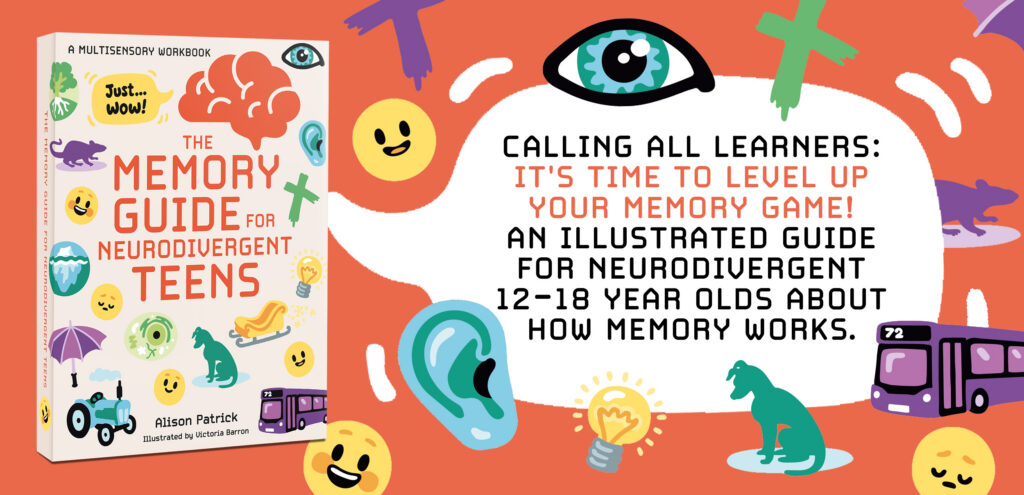
Written by Alison Patrick. You can pre-order Alison’s upcoming book, The Memory Guide for Neurodivergent Teens, here.
If you’re a Neurodivergent (ND) teen, you’ll find that you carry a mental load and that you’re not just ND at school, you’re ND in your regular life too. This can make for a stressful life. It can wear you down over time and knock your confidence. So, here are some aspects of life that can be affected and some easy strategies you can try to ease your way.
Organisation
Organisation is often one of the hidden stressors of being neurodivergent.
Shoes, coats, keys, books, mugs of tea. Everything seems to get lost, all day every day. Things hide in plain sight. One minute the lost shoe isn’t in a corner of the landing, two minutes later it is. It was there all along. And that’s down to the Executive Function (EF) part of your brain not managing to focus fully on the basics of daily life, because your EF brain actually finds the basics of daily life quite boring.
I’m DAudhd (dyspraxia, autism and ADHD) and I’ve experienced this every day of my life, for as long as I can remember. It’s stressful, right?
Here are some strategies to try for chaos and losiness:
- Pack your bag the night before.
- Have a note stuck to the back of your bedroom door listing everything you’ll need for the morning.
- Have a regular place where you put the important stuff e.g. hang your keys up the minute you get through the door. Hang your coat up. Put your shoes away. Have a regular place for your bag.
You won’t get this right all the time, because you’ll still be forgetful but Habits and Routines will help, I promise.
Attention/Concentration
Difficulties with paying attention/concentrating can be a core part of being neurodiverse. It can be impossible to focus for a whole school day when you’re having to sit still in a room and take a lot of information in, while your mind is constantly distracted by your own thoughts and what’s going on around you. That’s a big and tiring mental load to carry with you.
Here are a few things that can help with focusing in lessons:
- Wear a fidget band on your wrist
- Doodle
- Ask your teachers about seating. Whereabouts are you least distracted (back/front/middle)?
Be Active
There’s one other easy strategy I’d recommend to help clear the never-ending buzz of your ND mind:
Be as physically active as you can at break times and outside school.
If you’ve got an attention deficit and you’re in a confined school environment five days a week, then you’ll have a lot of energy to burn off.
Procrastination
If you’re neurodiverse, you’ll often put off tasks e.g. homework/tidying your bedroom and miss deadlines until life becomes Very Stressful.
You could try:
- The Three Second Rule – just starting the task can help.
- The Pomodoro Technique – breaking the time you spend on a task into four 25 minute chunks with five minute breaks and a longer reward time at the end.
- Pomodoro apps:
- Focus to Do
- Forest
Sleep ZZZZZZzzzzzzzzzzzzzzzzzzzzzzzzzz
That buzzing mind affects sleep doesn’t it? And being hyper aware of the sensory stuff around you can affect sleep too.
Here’s a few tricks to help you on your way to sleeping better:
- TRY to come off your phone an hour before bedtime – I know it’s hard, but it works, trust me.
- Try the Navy Seal/Submariner Square Breathing strategy where you:
- Breathe in to the count of 4
- Hold for the count of 4
- Breather out to the count of 4
And while you’re doing all those 4s, don’t let a single thought passing through your mind distract you.
That way you’ll help your restless ND mind to settle down, and it will be so bored that you’ll go to sleep.
- And if you can’t wake up in the morning? Have a backup alarm clock in the wardrobe or on the landing to force you out of bed and into the day ahead.
Social skills
Social life can be difficult when you’re neurodiverse.
I find that my social skills depend on who I’m with. There are times when I’m in a group social situation where I’m the shadow in the corner – the words just won’t come out. Other group situations, I’m at ease and I can talk. It depends on the group.
Social Anxiety
Here’s a tactic I use to ease my way with the social side of life:
Observe
- Look properly at the people around you. Watch their body language and their facial expressions too. Are they feeling awkward too? This can help to take you out of your own social anxiety.
Rejection Sensitivity
It can help to realise that although ND brains don’t always get the full picture, they can overthink things too and this can have a big impact on our social wellbeing. If we think someone has ignored us, it triggers a strong emotional reaction, and this can happen a lot. We can also hyperfocus afterwards on something that was said to us, even though we had a nice time with a group of friends.
Here’s how I strategise for rejection sensitivity:
- I accept that it’s part of having an ND brain.
- I try to anchor people in my memory visually and remember the nice times we’ve had socially.
- I think about what I’d say to a friend who was having these thoughts.
- I take a step back and think about different perspectives and reasons for what happened.
The Anxiety
So, there we have it. All these mental loads that come with having a neurodivergent brain can take their toll and lead to a Lot of Anxiety (and emotional upsets too).
You could:
- Defer worry by using the Worry Later strategy, where you set aside 10 minutes a day for worrying.
- Or try a worry board where you log your worries each day.
One last thing…
Hopefully, some of the strategies in this blog will help you to feel less burdened by the mental load of Neurodivergence.
Remember: it’s not all doom! I’m sure there are aspects of your ND mind that you wouldn’t be without. Here are a few of the things that you might recognise:
- the sparky, outside the box thinking and problem-solving.
- the resilience – when you are knocked down by life, you bounce back up and best foot forward it.
- when you do focus, you can really focus.
Here’s one last strategy to help you take a break when it all gets to be too much:
The Stop Strategy
- Stop
- Breathe
- Observe the world around you.
- External noises
- Breathing
- Body sensations
- Return to what you were doing or do something different.
(Zylowska 2012, p.86)
Alison Patrick is an SpLD tutor for students with dyspraxia/DCD and dyslexia, and an ADHD and Autism coach. She has extensive experience of SEND in schools, colleges and universities. She has also designed and presented PATOSS webinars on SpLDs for SEN teachers, students and parents. Her books include The Dyspraxic Learner, We Are the Dyspraxia Champions!, and The Memory and Processing Guide for Neurodiverse Learners. Her latest book, The Memory Guide for Neurodivergent Teens, publishes in August 2026 and is available to pre-order now.